
There’s one clear way to know that PPI’s trip to YIMBYtown 2026 was a rousing success: I fell asleep at the airport and missed my flight home. Delta graciously found me a fresh route, and now that I’ve recovered, let’s relive the highlights of a busy and rewarding week at the biggest national pro-housing conference in the country.
This year we were welcomed to Raleigh by “Mayor of YIMBYtown” Jenn Truman and her team at CITYBUILDER. They brought together 1,000+ advocates, policymakers, researchers and developers. For me it was a week full of equity, abundance, and optimism.
Clearly on display was the rising role of land value tax (LVT) within the wider urbanist movement. One year ago, PPI’s Russell Richie returned from YIMBYtown 2025 noting that LVT was a common point of conversation but hadn’t been the focus of any panels. This year was a sea change, with PPI contributing to an LVT table, a “Tacos & Taxes Happy Hour”, and three conference sessions that touched on LVT (plus two more from our friends at the Center for Land Economics).
We came home convinced that the YIMBY movement’s next frontier is the funding fight, where LVT is an indispensable tool.
LVT was impossible to miss
As a sponsor of YIMBYtown, PPI hosted an LVT table throughout the conference, decked out in Georgist green and gold. Conference-goers were drawn to it in droves. Lizzie Magie’s The Landlord’s Game, the predecessor to Monopoly, drew a steady stream of “Wait, is this the original Monopoly?” Our 3D map of Raleigh’s land values made our core point visible at a glance: when people come together in cities, they create enormous land value, and that community-created value is the focus of our work. Again and again, visitors told us, “Oh, the land value tax? I’ve heard about this,” then followed up with sharp questions about how it works and what it could do for their own communities.
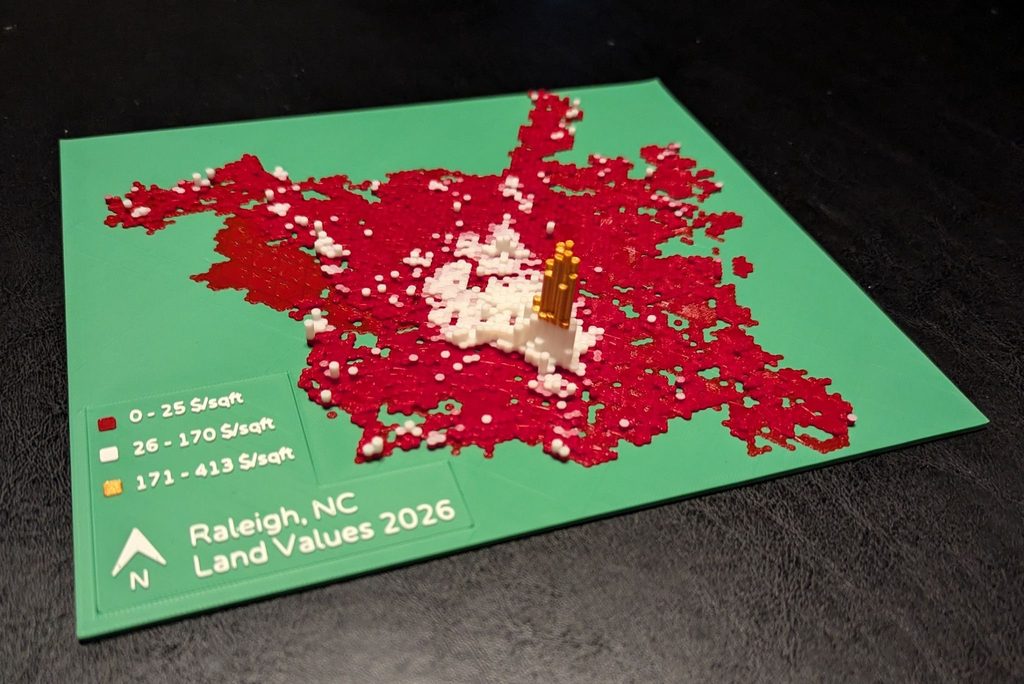
Featured at the LVT table: a 3D map of land values in Raleigh
We were joined at the table by a brilliant bunch of friends and collaborators, part of a growing community of LVT advocates who are working together to move the whole movement forward. From the Center for Land Economics, we had Lars Doucet (whose signed copy of Land is a Big Deal was a major draw for our raffle), Greg Miller (who led a session on vibe-coding pro-housing advocacy tools), and Jeff Fong (who joined a panel on building a movement through blogging: check out his own debrief of YIMBYtown here). Max Clark of Common Ground USA and David Bjorndalen of Baltimore Thrive also generously volunteered their time to staff the table with us.
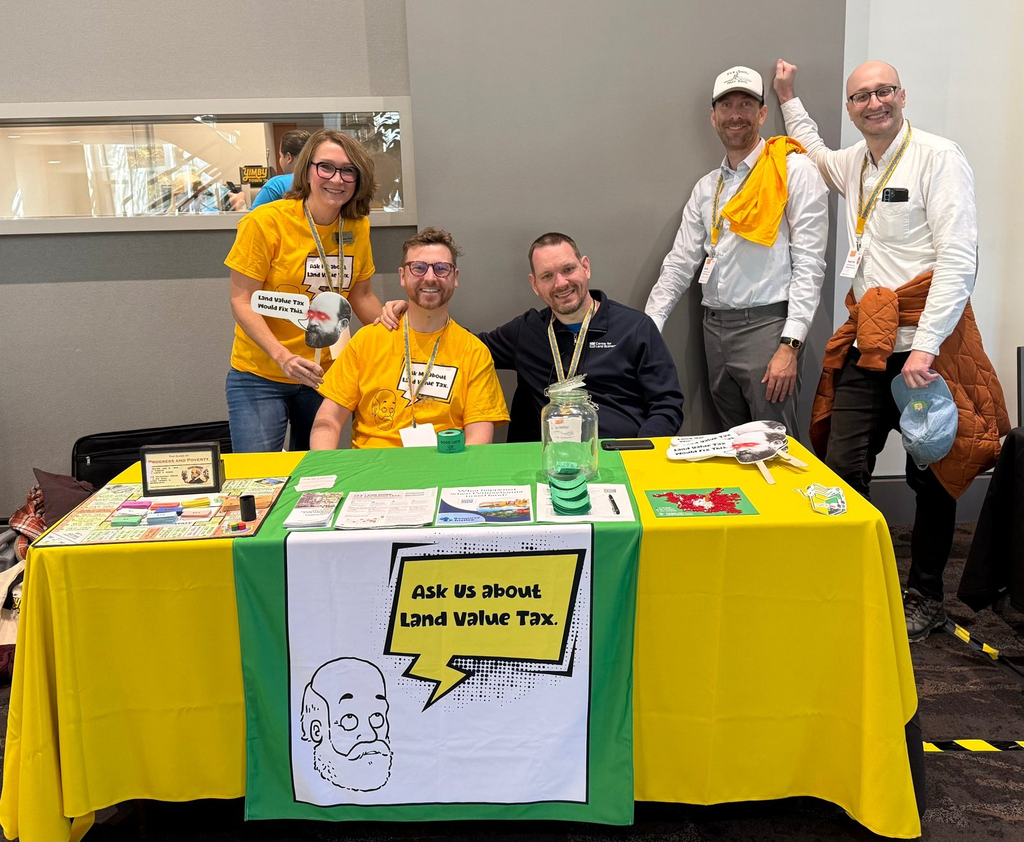
PPI staff with Lars Doucet (center, CLE) and Max Clark (second-from-right, Common Ground) at the LVT table
On the first night of the conference, we hosted Tacos & Taxes: An LVT Happy Hour at Slim’s Dive Bar downtown. All 120 tickets were sold out by midday, and word clearly spread through the conference from there: we estimate about twice that number came through over the course of the night. The taco bar was picked dry, and we spent much of the evening encouraging the crowd to head out to the patio once they’d grabbed a plate. Congratulations to our raffle winner, the impeccably dressed Josh Boehm, Founder of Endure, who took home our swag bag.
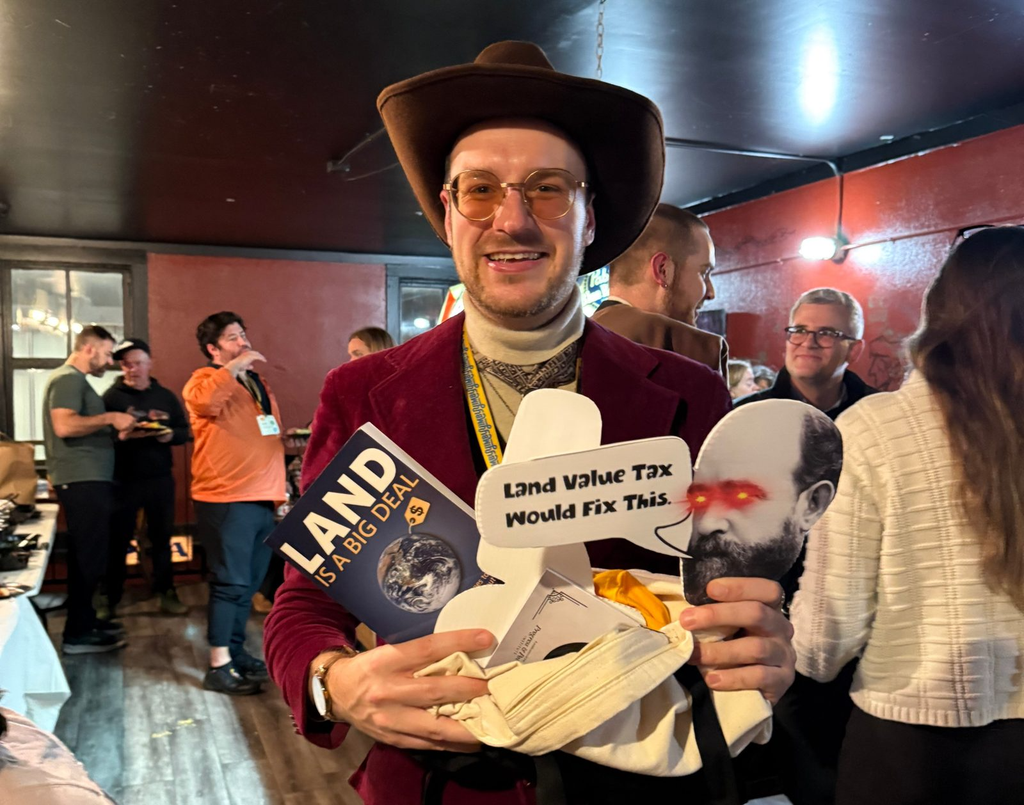
Raffle winner Josh Boehm of Endure
That level of enthusiastic turnout clearly reveals the rising interest in LVT among urbanists, and the continued importance of integrating LVT advocacy into the wider YIMBY movement.
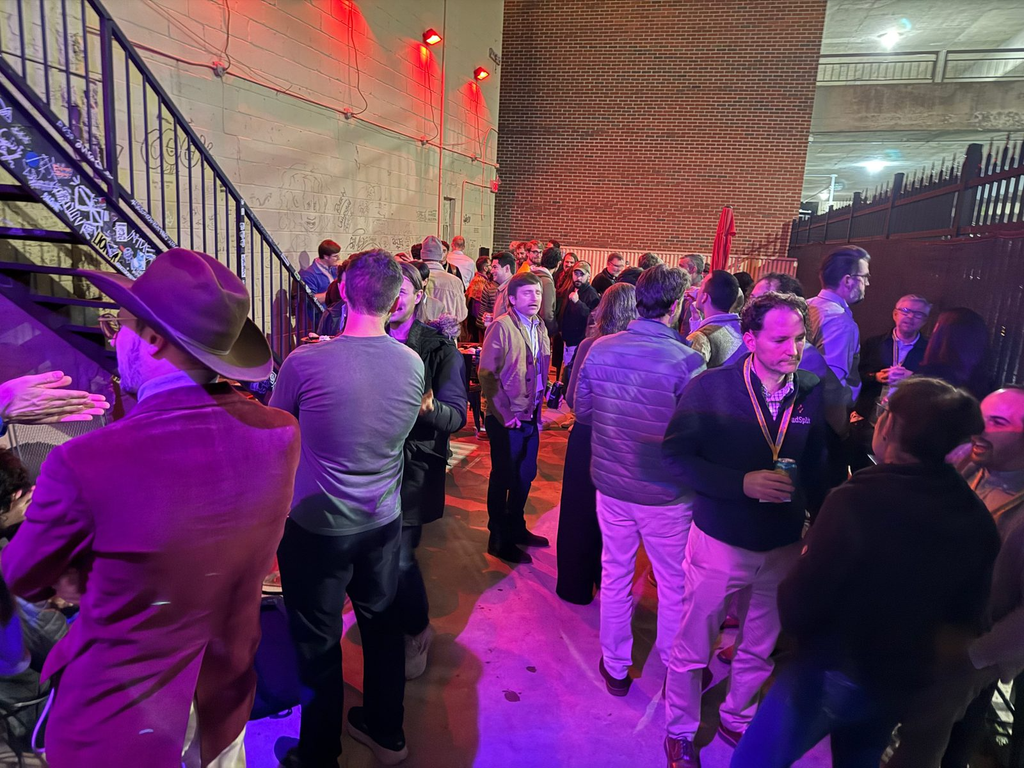
The Tacos & Taxes crowd spilling over onto the patio at Slim’s Dive Bar
Making LVT click
We weren’t just there to throw parties and network: All three PPI staff presented at a conference session, and each helped LVT to resonate in a different way for a different audience.
Combatting the Speculative Land Market. The YIMBY movement in recent years has made a deliberate effort to engage with wider advocacy for economic and social justice, which was why this year’s official themes included housing stability, inclusion, and community trust. That equity focus was on full display at Russell’s panel titled ‘Combatting the Speculative Land Market’.
Dayna Lazarus (Florida Housing Coalition) covered the history of community land trusts (CLTs) as an effort to combat land financialization and speculation, which Brittany Palmer brought to life by describing the work of Front Step CLT in Missoula, Montana. Next, Ryan McKinless of Birdsong Housing Partners explained how land leasing can produce affordable housing on public land. Lastly, Russell’s presentation on LVT was the thread that tied these three tools together: sharing community-created land value ensures that rising land values lift all boats, rather than capsizing those at the bottom. Russell closed with a question we’ll be chewing on for some time: if land value is created at many geographic scales — from the neighborhood to the city to the nation — what does it look like to share land rent at each of these levels? Their full presentation is here.
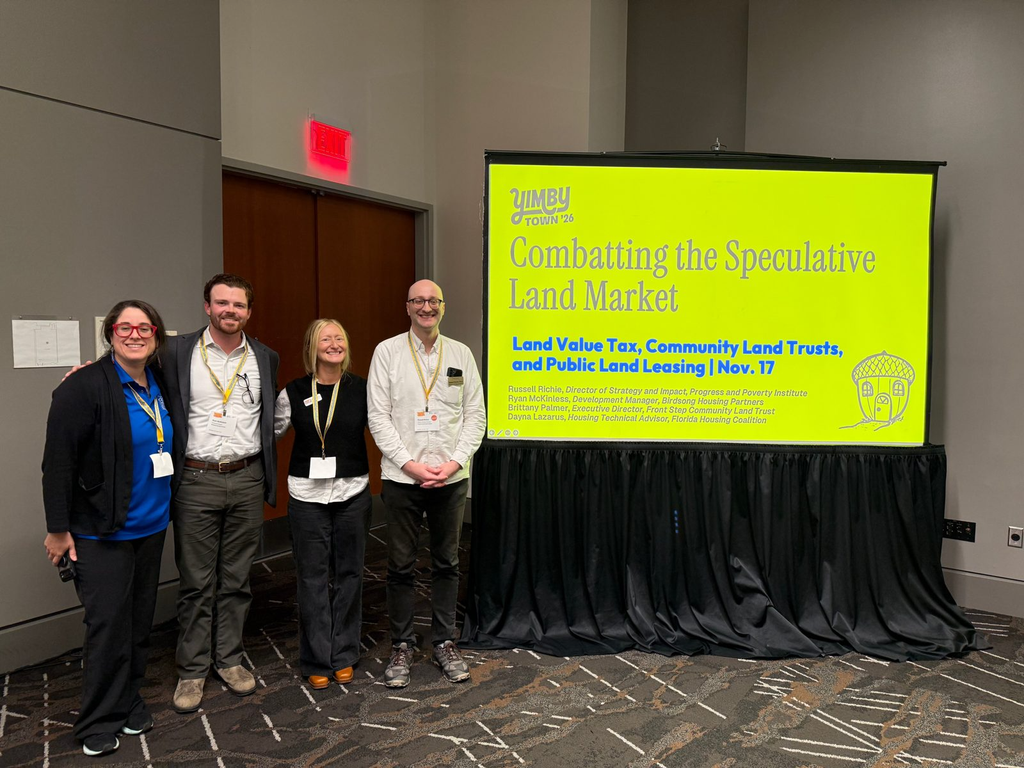
From right to left: PPI’s Russell Richie and his co-presenters Brittany Palmer (Front Step CLT), Ryan McKinless (Birdsong Housing Partners) and Dayna Lazarus (Florida Housing Coalition)
Land is Not a Toaster. My talk was pitched at researchers in the room: a 15-minute speedrun of urban economics, which mapped the frontier of what YIMBYs do and don’t (yet) know about how housing markets work. Each of my three puzzles pointed to a unique property of land. Over time: land is permanent, so landowners hold an option on when to build, and often prefer to wait, even when building is profitable. In space, land is fixed in place, meaning that local rents adjust to capture all the unique advantages of each location. And across the universe of locations: rents are set at the margin, so zoning and speculation raise rents everywhere by degrading everyone’s next-best option. You can flip through the slides here.
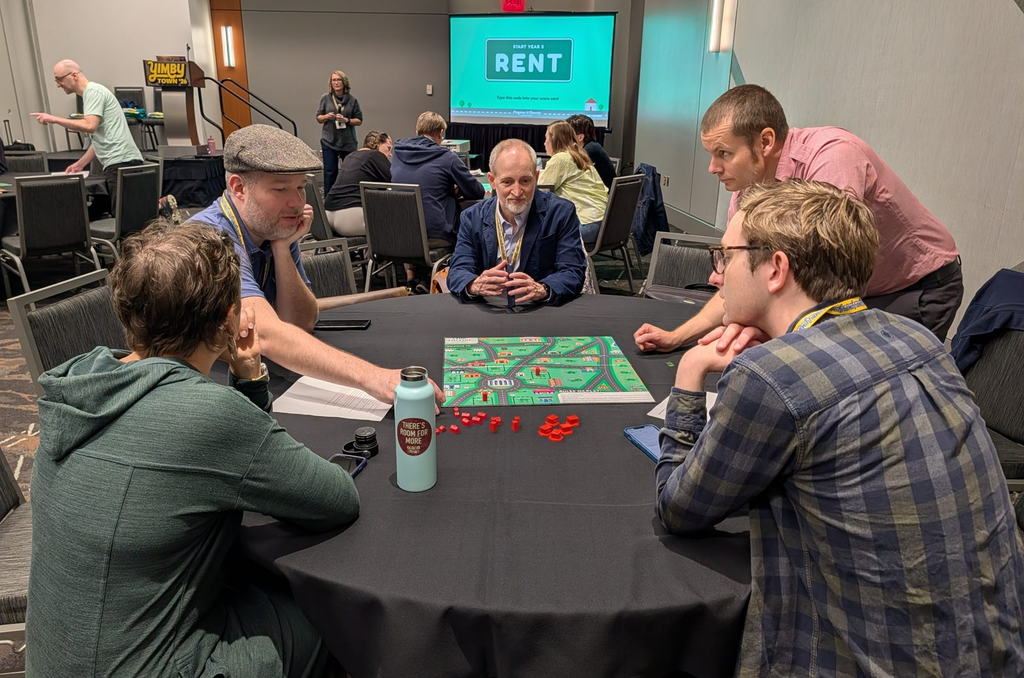
Attendees deep in discussion during Josie’s Land Locked session
Land Locked. On the last day of the conference, more than 50 LVT-curious practitioners split across six tables to play Land Locked, a board game designed by PPI Executive Director Josie Faass. Players took on the role of for-profit developers, tasked with developing their town over time to maximize their company’s value. The twist: some towns were funded by a property tax, while others used a land value tax. That seemingly minor difference led to drastically different results. Check out the slides here, including results for each town!
Unsurprisingly, the LVT towns densified downtown, produced less sprawl, and saw less vacant land held for speculation, while delivering the most value for shareholders. Perhaps unsurprisingly for the YIMBYtown crowd, players were deeply engaged in discussing their strategy throughout, and when Josie walked them through the results, many shared that the game had helped bring their understanding of LVT into the real world. Several had playful suggestions for expansions of the game: “What if developers had to grapple with several years of permitting and community review?!” Clearly, there’s plenty more fun to be had.
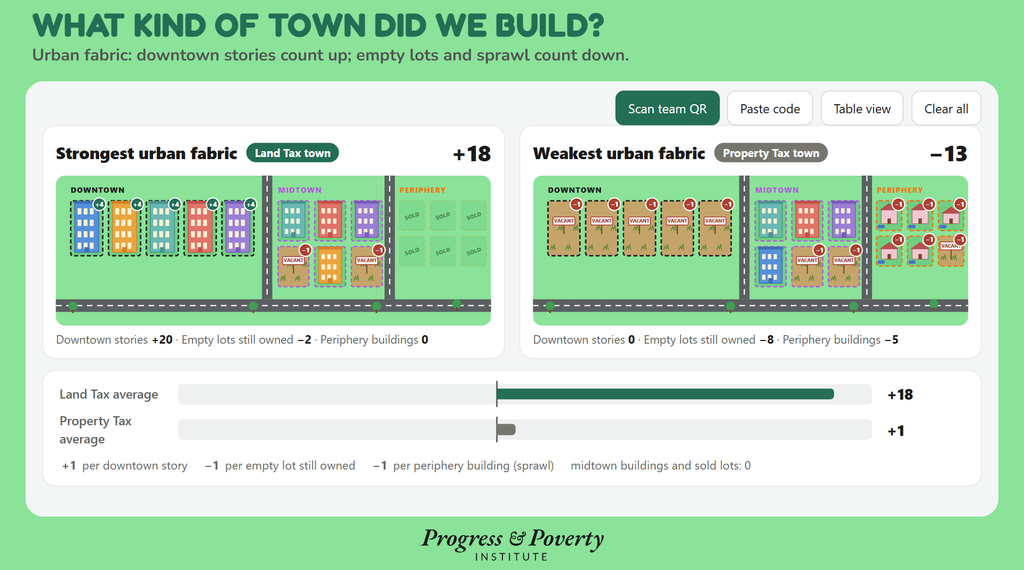
The results of Land Locked: LVT towns built a better urban fabric than the property tax towns, which were rife with sprawl and speculation.
Key conference themes: the funding fight
Beyond our own events, a few themes kept emerging during sessions and conversations throughout the conference. The biggest: YIMBYs are winning the zoning fight; the next one will be over funding.
Opponents of new housing have responded to YIMBY zoning wins by erecting new barriers which make development difficult: exacting impact fees, unfunded inclusionary zoning mandates, and community demands that must be negotiated project by project. As YIMBYs run into these new barriers, LVT becomes an even more attractive tool for funding city services and urbanist infrastructure without becoming a backdoor way to kill development (in fact, it does the opposite). LVT serves both equity and abundance: it captures community-created land value, uses it to pay for the infrastructure that supports growth, and manages to do so without penalizing development.
Meanwhile, the question that Russell raised last year has grown in importance: how can we find funding for active and public transit without kneecapping development? LVT would fix this. In New York for example, public finance experts (including Greg from CLE) are making the case that the Interborough Express should be funded by capturing the land value it creates.
Both patterns support the case I’ve been making for years: LVT and YIMBY are better together. As Josie put it while debriefing YIMBYtown 2026:
“As YIMBYs continue to rack up wins, they’re excited to embrace innovative public finance mechanisms that not only collect much-needed revenues, but also actively support good urban form. Likewise, Georgists are in a new era of embracing collaboration in the spirit of achieving real world change.
It feels like exactly the right moment to combine forces and realize the mutual benefits for our movements, communities, and cities.”
Not everyone is quite convinced. The main hesitation we encountered was a political one: a sense that LVT’s time will come in the next decade, not the next legislative session. We see that as a call for LVT supporters to roll up our sleeves and get to work. There is no better way to do that than by learning from the YIMBY movement itself, which has brought zoning reform from a wonky corner of Twitter out into a movement racking up wins across the nation. And there is real reason for hope: we heard interest from at least one funder eager to support studies on property tax reform and LVT.
What comes next
On Wednesday night, PPI hosted board members and staff from Philadelphia-based 5th Square Advocacy at our Airbnb, for drinks, dinner and a playtest of Land Locked. It was a timely gathering: as PPI kicks off its new strategic plan, Russell will be focusing much of his work on LVT advocacy in his beloved Philadelphia and throughout Pennsylvania.
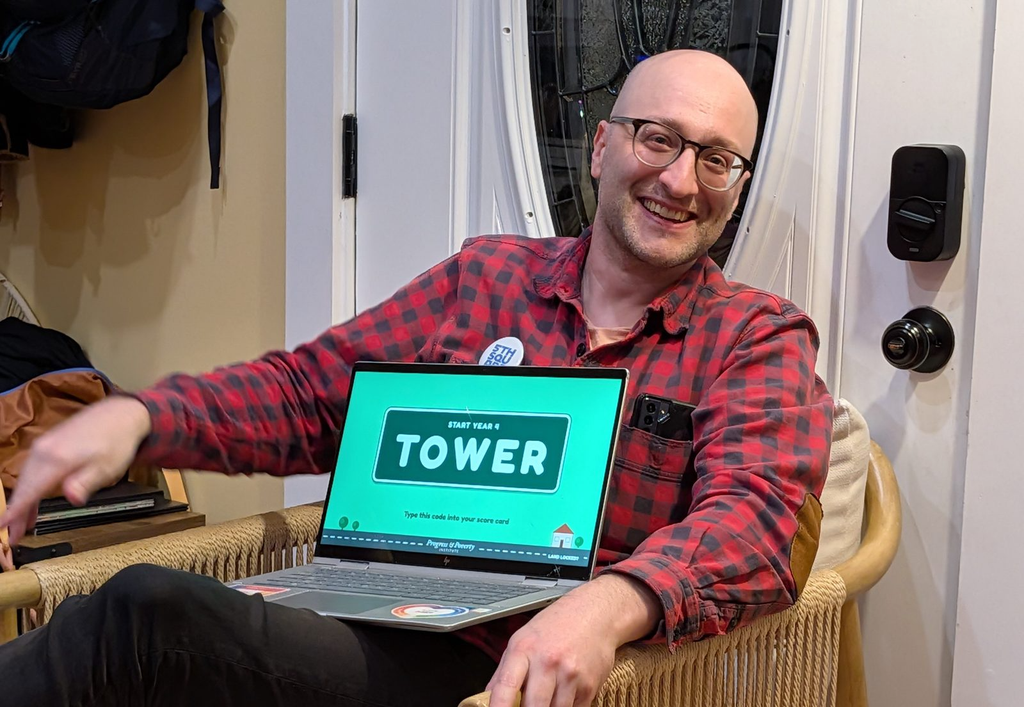
Russell Richie guarding the door as our dinner guests were treated to a Land Locked playtest
We left Raleigh exhausted yet energized by all the great work happening across the YIMBY movement, and hopeful about what our two movements can achieve together. If you’d like to help us carry that momentum into the year ahead, please consider supporting our work.
