
Championing an LVT and Citizen’s Dividend, Opportunity wins election to Parliament
Land value tax (LVT) continues its winning run. So far in 2026 we’ve seen wins for LVT in Virginia, New York, Louisville, Seattle and even Germany. Now we can add a national parliament to the list.
On November 7th, New Zealand’s Opportunity Party won about 6% of the party vote, campaigning on a platform that included using a land value tax to fund a Citizen’s Income (a universal basic income). On preliminary results, that gives it 7 of the 131 seats in Parliament. Special votes are still being counted, and the coalition talks that follow may even leave Opportunity holding the balance of power.
It has been a long road. Opportunity was founded ten years ago and has repeatedly been frustrated by falling short of New Zealand’s 5% threshold for entry to Parliament. Back when I wrote about Opportunity’s two-phase LVT plan during the 2023 election, the party won only 2% of the vote. This time around, they smashed through the threshold. With a charismatic new leader, a professionalized campaign, and an electorate fed up with both major parties, Opportunity won 6% of the party vote and will seat seven new Members of Parliament (MPs).
So, let’s get to know Opportunity and its Tax Reset. We’ll revisit New Zealand’s forgotten history of taxing land, find out what has brought the idea back to the fore, dig into the details of the Tax Reset, walk Opportunity’s road to Parliament and its potential role as kingmaker (and possibly in government), and learn some lessons for LVT advocates elsewhere.
Pioneering with land taxes
New Zealand’s long history with LVT predates Progress and Poverty itself. Drawing on Ricardo and Mill, Premier Sir George Grey passed the Land Tax Act in 1878, the young colony’s first direct tax. Sadly, Grey’s government collapsed a year later, and his land tax was swiftly replaced with a broad-based property tax. Grey went on to become New Zealand’s premier Georgist, even having Henry George’s steamer held for two hours when it passed through Auckland in 1890 so the two could meet. A national Single Tax League formed soon afterwards.
“[Ballance] advocated the programme of Henry George as a means of ‘bursting up the great estates’” — Martin Daunton, State and Market in Victorian Britain (2008), on the 1890 election
Later that year, Grey’s former Treasurer and another Georgist, John Ballance, led the Liberals to power. Their 21 years in government laid the foundations of the social democracy New Zealand still enjoys today: women’s suffrage (first in the world), old-age pensions, labor protections, free secondary schooling, accident insurance and the beginnings of state housing and public health. Swiftly passing the Land and Income Assessment Act 1891, the Liberals restored LVT with a graduated land tax: a penny in the pound on land values, with small landholders exempt, plus an extra tax on large estates, increasing with their size. The tax was designed to break up the great estates and revive the colonial-era New Zealand Company’s ideal of “an equal society of yeoman farmers.” By 1895, it was responsible for three-quarters of national revenue from direct taxes. Next came an 1896 act that let voters shift their local taxes (called council rates) onto land, which many proceeded to do over the subsequent century. By 1982, 90% of local councils had adopted land value rating.
1. Until a November 2025 rebrand, the party was known as The Opportunity Party, or TOP. I use “Opportunity” throughout.
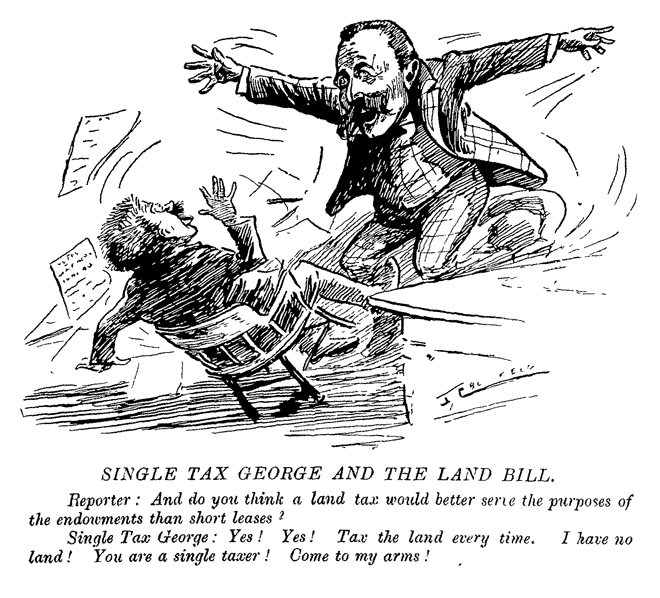
“Single Tax George and the Land Bill.” New Zealand Free Lance, 30 March 1907, p. 14, via Te Ara.
However, a simultaneous retreat from LVT was taking place at the national level. Income tax overtook the land tax during the First World War, and broad exemptions for farmland and homeowners eventually left only 5% of land value taxable. The final blow came in 1990, when the Labour government abolished the land tax in the dying days of Rogernomics, the free-market revolution named after its former Finance Minister, Roger Douglas. Ironically, Douglas was once a member of the Land Value Rating Association.
Local LVT came under attack in the same era. In 1988, the government scrapped the ratepayer polls that had decided each council’s rating system for nearly a century, handing the choice to councils themselves, and many, especially in high-value urban areas, switched to taxing capital value instead. Today, about 29% of councils still rate on land value.
2. Rogernomics, named after Douglas, was New Zealand’s impression of Reaganomics: a sweeping program of deregulation, privatization, flatter income taxes and a new goods and services tax, launched by the Labour government elected in 1984.
3. These include Hastings, Kāpiti Coast (which combines fixed-charges, land rates and capital rates), Napier, Nelson, New Plymouth, South Wairarapa, Tararua and Whangārei.
What survives of this legacy is its institutional machinery. Every property in New Zealand is revalued every three years, the vast majority being completed by the state-owned enterprise Quotable Value. Land and buildings are valued separately, according to national rules and audits, with the public generally trusting these assessments as fair and accurate. American readers may be pleased to learn that critics of Opportunity’s LVT rarely raised concerns over the accuracy of valuations.
Addicted to house prices
Despite LVT’s disheartening demise, a familiar set of socioeconomic struggles has brought it back into New Zealand’s political debate. House prices have quadrupled since the turn of the millennium, and rose faster than in 12 comparable nations from the Global Financial Crisis through the COVID-19 pandemic. Homeownership fell from 74% in 1991 to 66% today. To its credit, New Zealand has made real progress on zoning: Auckland’s 2016 upzoning roughly doubled construction and left rents 26–33% lower than they would otherwise have been. But renters’ housing costs still rose 9% in the year to June 2025, and Auckland homes still cost about 10.5 times household income.
“We have traded houses among ourselves… in the belief that we were creating prosperity” — Paul Conway, Chief Economist, Reserve Bank of New Zealand (2022)
Land also sits at the heart of New Zealand’s inequality. The median mortgage-free homeowning household is worth NZ$1.29m (US$708k); the median renting household, NZ$57k (US$31k). The tax system only widens that gap. New Zealand has no comprehensive capital gains, wealth or inheritance tax, and doesn’t tax the imputed rent that homeowners enjoy, so, as I showed in 2023, property faces far lower effective tax rates than other investments. Even local rates fell from 2.2% of housing value in 1980 to 0.65% in 2008.
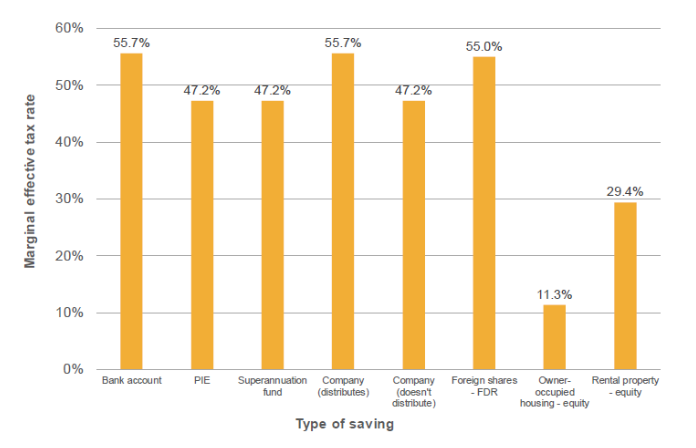
Marginal effective tax rates on different types of saving. Owner-occupied housing is taxed at 11%, compared to 56% for a bank account. Source: Treasury/IRD analysis in the Tax Working Group’s Future of Tax: Submissions Background Paper (2018), Figure 21.
Building a society dependent on ever-rising property values has created a fragile economy. With over half of household wealth tied up in property, the recent slump, which saw prices fall 15% from their 2021 peak, caused the economy to contract in three of the past five quarters. Even slashing interest rates in half from 5.5% to 2.75% has struggled to restart growth.
Meanwhile, capital pours into houses instead of businesses. Housing absorbs about 34% of total investment against an OECD average of 21%, and the OECD’s latest survey blames shallow capital markets, banks’ preference for lending against property, and a tax system that treats housing lightly. Little wonder the quarter-acre dream remains the national route into the middle class, and talking about the property market a national pastime.
Opportunity put these problems at the heart of its campaign, pitching the Tax Reset as a cure for New Zealand’s “addiction to ever-higher house prices.” It promised to bring house prices down, lift 50,000 families out of poverty, and shift investment out of property speculation and into productive firms. So let’s learn about their cure.
Tax Reset: invest in people, not property
Opportunity’s Tax Reset policy rests on three pillars. The first is a land value tax of 1.75% per year on urban land and 0.5% on rural land, both charged against full market value. It exempts Māori communal land, conservation land, and land owned by the government, social housing providers, clubs or churches. Opportunity puts the taxable base at about NZ $1.7 trillion (just under (US$1 trillion), meaning that the LVT will raise roughly NZ$24 billion (US$13 billion) per year, equal to around one-fifth of current tax revenues flowing to the national government.
The second pillar is a simplified tax & transfer system. Today’s income tax schedule, which rises over five brackets from 10.5% to 39%, becomes three brackets of 28%, 34% and 39%. That sounds like a tax hike until you add the third pillar: a tax-free and universal Citizen’s Income of NZ$19,400 per year (US$10,700) paid to every resident adult. The combined effect of these two pillars means that anyone earning under NZ$60k (US$33k) pays less income tax than the Citizen’s Income they receive. Because it replaces existing working-age benefits, which are clawed back at up to 70 cents for every extra dollar recipients earn, the Citizen’s Income significantly reduces the effective marginal tax rates of nearly 90% that beneficiaries face when they take on work. Additional payments are made available for children, sole parents, disabled people and housing.
“…shifting the tax load off working people and onto land” — Opportunity, on its land value tax (1News, 2026)
Opportunity is not shy about intergenerational equity being a core goal of its Tax Reset. However, it has shrewdly sidestepped the “old widow” problem that so often dogs LVT advocates: the fear that land-rich, cash-poor retirees will be taxed out of their family homes. Superannuitants can defer their land tax until the property is sold, so no retiree will ever have to sell their home to pay it. Crucially, this is a deferral, not an exemption: the tax is still owed, so the tax base stays intact. I flagged this problem in my 2023 article and suggested deferral as the fix (as had Barrett and Veal back in 2012), so I was pleased to see it here. Finally, the Tax Reset folds NZ Super, New Zealand’s universal pension, into the Citizen’s Income, with top-ups to ensure that current superannuitants are no worse off.
Farmers are the other hard case when implementing an LVT in New Zealand. They are seen as the backbone of the economy and carry significant political cachet. That’s why, even though it produced 53% of gross emissions in 2024, agriculture was removed from the emissions trading scheme that November. Hence the lower rural rate, an exemption for privately held conservation land, and deferral in bad seasons. Despite these carve-outs, Federated Farmers (the farming lobby) still claimed the tax would take NZ$700m (US$385m) a year out of the rural sector and leave most farming households worse off. However, they didn’t publish their method and ignored my repeated calls and emails asking for a copy of their analysis.
When pressed on the campaign trail, Opportunity pushed back, saying smaller farms would benefit overall. Deputy leader Daniel Eb stressed the upside for the next generation, since inflated land prices are locking young farmers out of farm ownership, while the option to defer also protects farmers through bad seasons.
None of this would happen overnight. Opportunity’s transition plan starts with two years of policy design, then rolls out the Citizen’s Income by age group, starting with 18–29 year-olds, and phases in the land tax over the following years.
Who wins and who loses?
Opportunity was crystal clear about who would win and lose from its Tax Reset. The party claims about 70% of people would be better off and 20% roughly unchanged. Renters and low-income workers gain most, most homeowners enjoy a tax cut (apart from those who own more than their fair share of land), and land bankers and speculators lose.
To test this, I updated my 2023 analysis to fit the 2026 Tax Reset. The chart below shows how the Tax Reset would change the after-tax income of a working-age adult depending on how much they earn and how much land value they own.
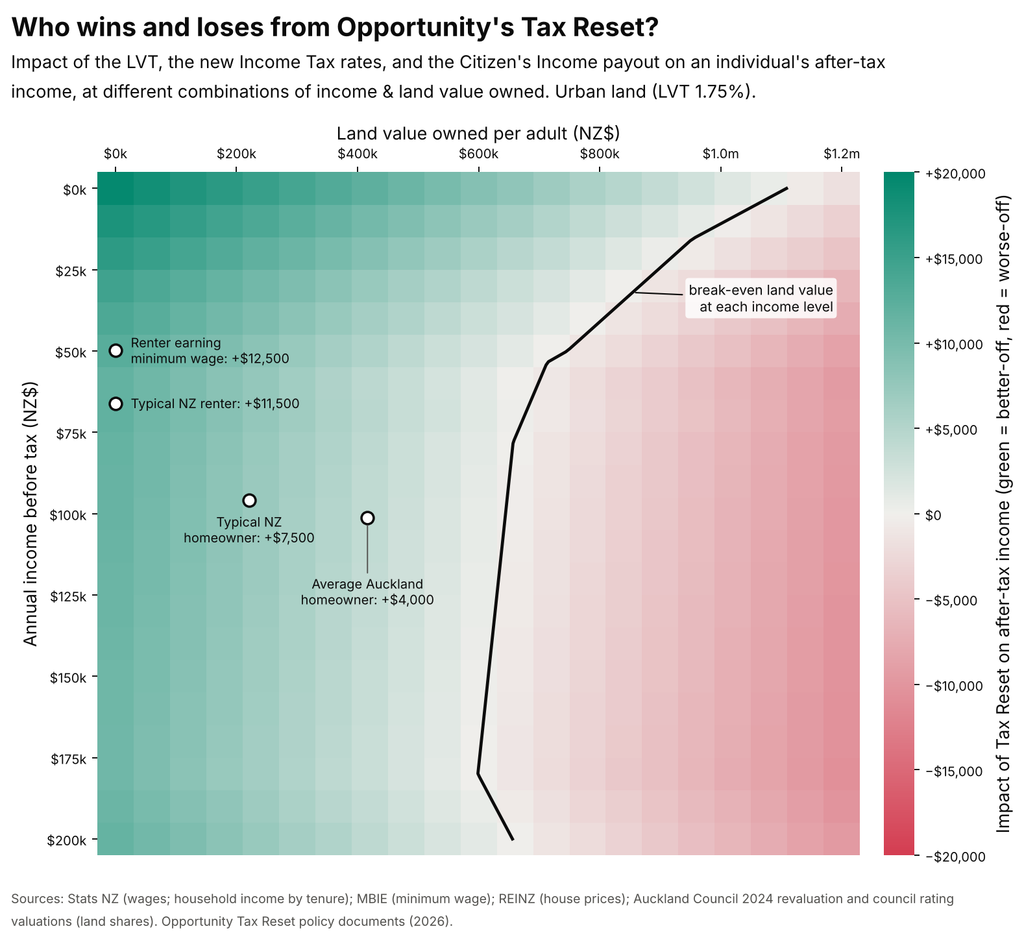
Here we can observe the power of pairing a land tax with a citizens’ dividend for improving political viability. Every renter earning up to NZ$200k comes out at least NZ$10,000 a year ahead. A renter on the full-time minimum wage sees their take-home pay increase by about 30% (+NZ$12,550), and one on the typical renter income gains NZ$11,450. Most homeowners win too: a homeowner with the national median land value (NZ$221k each, as part of a couple) gains NZ$7,450, and even one who owns half an average Auckland section (NZ$416k) gains NZ$4,000.
The picture may be less rosy at the very bottom, due to existing benefits largely being replaced by the Citizen’s Income. Despite Opportunity’s promise that no one on a current benefit will receive less, Michael Fletcher found the gains are thin for beneficiaries: before housing payments, a single Jobseeker gains less than NZ$50 a year, a sole parent on benefit NZ$2,850, and a person on the Supported Living Payment with a full Disability Allowance actually loses about NZ$1,000.
Unsurprisingly, land rather than income separates the winners from the losers. For anyone earning between NZ$55k and NZ$180k, the break-even point sits at about NZ$600-680k of land per adult, or NZ$1.2-$1.35m for a couple, because across that range the new 34% rate is close to the 30–33% people pay today. As the NZ Initiative’s Oliver Hartwich found, even a couple each earning NZ$500k with NZ$1m of urban land comes out ahead.
NZ-based research backs the broad design of the Tax Reset. A 2009 IRD and Treasury paper found a land tax can’t be passed on, and falls on owners when it is announced. Coleman and Grimes modelled a land tax under which, with housing supply fixed, prices fall about 10% while rents barely move, and estimated that a 1% tax on all non-government land would raise around a fifth of income tax revenue. Gupta concluded that LVT is the most efficient tax available, and that New Zealand already has the valuation infrastructure to implement it. And tax experts both domestic and international, from the 2010 Tax Working Group to the IMF and the OECD, have recommended an LVT for New Zealand.
How Q’s Opportunity broke through
So, what carried Opportunity into Parliament this time around? Its breakthrough came in an election largely fought on a weak economy. Some analysts consider New Zealand to be in its worst shape since the global financial crisis, unemployment has hit 5.7%, and a record 72,700 citizens left the country in the year to September 2025. Unusually, tax was also at the center of the campaign, in what one adviser called one of the most significant elections in decades for tax policy: Labour proposed a capital gains tax, the Greens a wealth tax, and National promised no new taxes at all. Disillusioned voters deserted the two major parties in droves: their combined support fell below 60%, against historic norms above 80%.
Into that gap stepped the serene and charismatic Qiulae (“Q”) Wong. Born in Fiji in 1988 and raised in Auckland, she studied law and politics, spent nine years in London as a sustainable business consultant, and is a mother of two and a former Green Party member. Remarkably, she wasn’t even a party member when she answered Opportunity’s job ad for a new leader on the Kiwi jobs website SEEK. Ms. Wong took over in November 2025 and broadened the party’s platform to include improving the cost of living, a renewed commitment to climate change and environmental protection, and cleaning-up politics. Her composure under fire won praise from commentators, who described her as “serene as chaos erupted all around her” in one televised debate and “calm and in control” as Finance Minister Nicola Willis turned on her in another. She even drew comparisons with the popular former prime minister Jacinda Ardern, and fittingly, Ms. Wong stood in Ardern’s old seat of Mt Albert.

Opportunity leader Qiulae (“Q”) Wong.
The party also got serious. It brought in an experienced ex-Labour minister as general manager, fielded candidates in about 30 electorates (up from 13), and thousands of new members ran an old-fashioned ground campaign. It sold its “radical centrism” with far less desperation than nearly a decade earlier, when its rambunctious founder Gareth Morgan dismissed Ardern as “lipstick on a pig.” It drew voters from across the political spectrum: about half from Labour or the Greens, a quarter from the right, and around 10% from new voters.
Sitting in the middle meant taking fire from both sides. Prime Minister Christopher Luxon quipped that the party was “as centrist as I am an All Black,” and the Taxpayers’ Union called it far left (despite backing a land tax itself in 2018). On the left, Greens co-leader Chlöe Swarbrick contrasted her party with an Opportunity willing to put Luxon back in power, and left-leaning influencers branded it a “trojan horse for the right.” Long-time LVT supporters won’t be surprised; land value tax has features that appeal to values on both the left and the right.
On preliminary results, Opportunity won just shy of 150,000 votes (out of about 2.4 million counted on election night), entitling it to seven MPs when the new Parliament meets, which must happen by January 14th. Ms. Wong won 12% of her local vote in Mt Albert, while Sarah Lucas, who looks set to be Opportunity’s seventh list MP, was also a strong local performer, picking up 6% of the vote in New Plymouth, a regional oil and gas town.
Kingmaker or opposition?
Under New Zealand’s multi-party system, parties must band together to form a coalition with a majority of seats in Parliament. With both traditional blocs weak, polls had Opportunity holding the balance of power for much of the campaign, and Ms. Wong used that potential kingmaker role to keep the media focused on Opportunity’s platform.
On election night, the governing coalition of National, ACT and NZ First won 67 seats, one more than the 66 needed to govern. For now, this means that Opportunity will not be kingmaker, but the outstanding special votes usually lean left. If they erase the right’s majority, there’s a catch: National and NZ First both ruled Opportunity out before the election, so a hung Parliament, and even another election, remain possible.
Either way, a land tax is unlikely this term. ACT would only consider supporting Opportunity if it dropped its tax plans, and Labour, while preferring a government with the Greens and Opportunity, says there is “no way” it will back the tax policy. Opportunity’s own bottom lines don’t include the Tax Reset, and instead emphasize competition, lobbying and donations, health, bottom trawling and climate.
In my very humble view as a Kiwi living abroad, Opportunity would be better off outside government. History is not kind to New Zealand’s kingmakers: Bryce Edwards found that every minor party to govern alongside a major party since 1996 was punished at the next election, and the Alliance, NZ First and Te Pāti Māori have all been turfed out after a stint in government. Founder Gareth Morgan has advised the party to stay out of cabinet, and Ms. Wong says her goal is to survive into 2029. A term spent learning the ropes, building the party and using the opposition benches to make the case for land value tax would prepare it to govern in three years’ time.
Lessons from Aotearoa
So, what can those of us championing LVT overseas learn from Opportunity?
First, design your policy to maximize winners, and then tell them they’re winners. Our own forthcoming research (Richie, Miller, Hoskins & Faas) found that appealing to respondents’ self-interest was the only message that reliably increased support for LVT. Pairing LVT with a citizens’ dividend is the most direct way to turn most voters into winners, so that only people with above-average land value pay more (or, in the case of Opportunity’s Tax Reset, only people with more than about one and a half times their fair share of land value). Opportunity then made this information easily accessible, with an online calculator and a cast of “Kiwis of Tomorrow” characters drawn by local cartoonist Sam Moore.
Second, soften the blow for sympathetic losers with deferrals, not exemptions. New Zealand’s own history is the warning: exemptions left only 5% of land taxable, ultimately leading to the national land tax’s abolition. Deferrals answer the stated worry about displacement without eroding the base, and often leave critics arguing, in effect, for preserving inherited housing wealth: a landed gentry by another name.
Third, make the most of LVT’s appeal across the political spectrum. Our ideas solve problems that both sides care about, from unaffordable housing and inequality to weak investment and productivity, and they speak to values right across the spectrum: egalitarian and meritocratic, pro-market and producerist. Opportunity leaned into this by refusing to pick a side. But being neither left nor right also invites attacks from both.
Fourth, land value tax can’t carry a campaign alone. Opportunity spent three elections as a party of tax wonks (like me) and never topped 2.5%. What carried it into Parliament this time was a credible messenger and a platform built around voters’ everyday concerns.
Finally, this is a long game: a decade to get into Parliament, a ten-year transition plan, and another survival test in 2029. Opportunity’s arrival in Parliament is hopefully just the start of its influence.
New Zealand was once a pioneer of land value taxation. Opportunity has given it a chance to lead the world forward yet again.
