
Imagine living in tropic heat and going without running water for two days at a stretch. The scenario has spread to seven Puerto Rican municipalities, San Juan, Canóvanas, Carolina, Gurabo, Juncos, Loíza, and Trujillo Alto (Burgos, 2026).
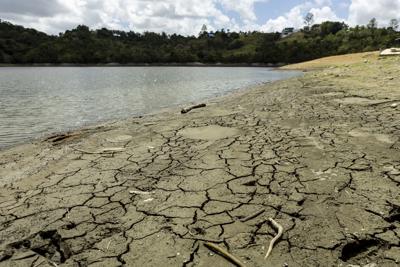
Puerto Rico’s water infrastructure, managed by the state-run Puerto Rico Aqueduct and Sewer Authority (known as AAA locally), suffers from a volatile mix of severe decay, financial strain, and extreme vulnerability to extreme weather. The island loses nearly 60% of its treated water before it ever reaches homes, due to massive leaks in aging pipelines, while recurring droughts frequently drop reservoir levels low enough to trigger multi-day service rationing.
Complicating matters, the water network is heavily dependent on the island’s notoriously fragile power grid, operated by a private entity, LUMA. All-too-common electrical blackouts routinely shut down water pumps and filtration plants, leaving hundreds of thousands without running water even when supply is adequate. Despite billions in federal recovery funds allocated following Hurricanes Maria and Fiona, execution delays and structural challenges mean everyday service interruptions, poor water quality, and supply instability remain a constant reality for residents (El Archivo de Borinquen, n.d.).
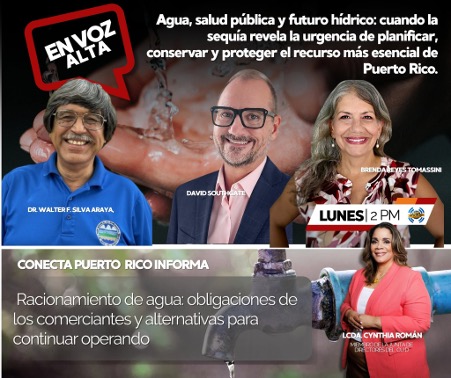
The following is a transcription of a live radio interview on WPAB 550 AM/ Eco 93.1 FM in Puerto Rico during an August 24, 2026 broadcast of Conecta Puerto Rico, a multiplatform radio entertainment magazine. The interview was conducted by Marisaida Morales, Annette Rodríguez, Jackeline Del Toro, and Alana V. Pagán during the segment En Voz Alta. PPI’s senior research associate, David Southgate, discusses how Puerto Rico’s water and energy crises disproportionately impact low-income residents. Southgate emphasizes that treating water as a commercial commodity rather than a fundamental public good exacerbates these inequities, leaving elderly and low-resource families without reliable access or basic adaptation tools like private cisterns.
To combat government neglect and systemic failure, community organizations like Un Nuevo Amanecer in La Playa de Ponce have stepped in to organize. Southgate is an embedded researcher with UNA and member of the board. He explains how residents are leveraging local data, community mapping, and grassroots social networks to drive neighborhood-led climate adaptation and take direct control of their own local infrastructure.
This interview was transcribed in Spanish using TurboScribe and translated to English with Google Gemini. The author verified the accuracy of both the transcription and the translation and made corrections where necessary to conserve the meaning.
A Crisis of Governance, Not Just Weather
MARISAIDA
And we return to Conecta Puerto Rico, where all voices meet. Now we move to the segment from a community and justice perspective—environmental justice, as Alana said. Who suffers the most, and what are our communities doing? To talk about that, we have our dear David Southgate here with us. Welcome, David.
DAVID
Thank you, thank you, Marisaida. It’s a pleasure to be here with you. Greetings to all the listeners.
MARISAIDA
David, your work focuses precisely on something that this crisis makes painfully visible: that a water crisis is not equal for everyone. Because when there is rationing, not everyone experiences it the same way. Communities with fewer resources have less capacity, right, to buy water tanks—to store, to stock up on bottled water—or to face prolonged, unexpected interruptions, because they don’t give you a heads-up either.
Rural communities and those furthest from the centralized system are always the first to be left without service, because that has been the problem all along. It’s recurring. It’s recurring, meaning, “I’m going to fix that little pumping issue you have,” and they never fix anything. That’s a reality we’ve heard a lot. That’s called a campaign promise.
GROUP
That’s right.
MARISAIDA
It’s the same thing. Especially in the south, where they have been dealing for decades with water quality and access issues that the rest of the island barely learns about when there is a drought.
David, based on your work in La Playa de Ponce, how do the most vulnerable communities in Puerto Rico experience this water crisis? And what is the difference between how a family in a condo with a private cistern faces it, versus a low-resource family with very little access to what is—because now it has to be said like that, exclusively the AAA (Aqueduct and Sewer Authority) system?
DAVID
Well, there is a phrase in Puerto Rico “cargarle al muerto” (to pin the blame/burden on someone else). Unfortunately, drought is a crisis of inequality. Sure, there is a drought, but at the root of the problems, if we look at the original causes, it’s a lack of good governance over public goods, right? At the root of this, we have inequity and a huge failure in the governance of public goods, including water.
MARISAIDA
Yes, because now it hit the water. First, it was the electricity, and now this blew up. Today we woke up to news that some parts broke, and instead of having them stored in a warehouse, right? Because you have to prevent. Of course. They don’t exist.
Well, they don’t exist at all. So those people have to wait for them to be brought here. How unbelievable.
DAVID
Yes, yes. In La Playa de Ponce, we are very proud of the community’s work here. The Un Nuevo Amanecer project that just wrapped up is called Raíces Costeras, and one of several elements of that project was to produce and execute a pilot neighborhood survey, and they did it.
The point of that data collection was to identify Vulnerability to Survival: how to survive if a disaster strikes. That is a combination of different factors, starting with exposure. In our case in La Playa, that’s flooding, extreme heat, and now drought.
The other element is sensitivity. We know that many communities in Puerto Rico have elderly residents, ages 65 and up. It doesn’t mean everyone at that age is frail, but there is a concern, and children under the age of 5 are also vulnerable.
MARISAIDA
We are seeing it on the news—the women themselves saying, “I’m already tired, I can’t carry the water bottles, the water jugs.” It’s not just that they are older and can’t; it’s that it’s… it’s tough, it’s exhausting.
DAVID
It’s tough and it’s exhausting, as is having access to water reserves. This is a physical obstacle—going out to get it—or mobility obstacles, like if a person is bedridden, uses a wheelchair, or simply lacks transportation or family nearby to help them. That’s another sensitivity measured by that survey.
Measuring Who Is Most at Risk
DAVID
The other factor was adaptive capacity, which includes social networks. I’m talking person-to-person, not necessarily digital ones. This includes income diversification; if you have multiple income sources, then if one disappears, you are adaptable and can adjust.
Or cisterns, or access to cooling centers. These are all elements of adaptation for climate change. We conducted the assessment, and a high number of people came up as having survival vulnerability if something happens. Un Nuevo Amanecer is channeling that information into a support network we have. Step by step, right?
Water as a Human Right, Not a Commodity
MARISAIDA
Yes, but it’s very important. No, and that data is wonderful. Someone is collecting that information, but we know that the EPA—we have knowledge that the EPA recently awarded over $500,000 precisely for stormwater, sewer, and pollution infrastructure projects.
In other words, federal funds are available, but from the announcement to actual execution there is a long road. How do we ensure that those resources and funds for infrastructure actually arrive equitably and reach the communities that truly need them? Or what obstacles do you see existing today that prevent it from happening?
DAVID
Yes, exactly. To use another example from La Playa, from the Un Nuevo Amanecer organization: we have worked to shift planning away from market-driven capitalism toward grassroots planning. This uses lived experience and local intelligence because, currently, climate adaptation happens at the local level. What happens in San Juan is very different from what happens here in La Playa de Ponce.
So, it also requires a shift in how we treat public goods like water. It is not a commodity. It is not a commodity.
MARISAIDA
Thank you.
DAVID
And treating it like a commodity is a violation of human rights. It is incompatible to think that stockholders, for example, who produce bottled water, control the price and access to water for many people. It is incompatible that company owners’ profits stand as a barrier to accessing this commodity, which shouldn’t be a commodity for anyone. It is a public good. So, a shift in ideology is required, a shift in how things are done—not only with water, but perhaps with electricity, education, and healthcare.
The Mental Toll of Going Without
JACKELINE
Of course. Moving a bit into healthcare and social justice . . . As a clinical psychologist, mental health is very important to me.
And we know that a lack of water isn’t just a logistical inconvenience for a family. Not having basic, essential resources can cause stress, anxiety, and a feeling of abandonment. David, based on your experience, I’d like you to share how this water insecurity affects well-being, health, and community cohesion, and what community strengths you’ve seen activated during these moments of crisis.
DAVID
Yes, sure. First of all, it’s important to remember that we have been suffering a cascading series of disasters: Hurricane Maria, earthquakes, COVID, Fiona, and now the drought, and I could add the Donald Trump administration as the cherry on top.
So, when public infrastructure is broken, what matters is the social network—the fabric of people who are your family, your neighbors, and the people you know in local, state, and federal government. And we must not forget the diaspora. Why? Because they are all part of the support system. And currently, as we learned during the abandonment after Fiona and Maria, “el pueblo salva al pueblo” (“the people save the people”).
JACKELINE
Definitely.
DAVID
So, if we know as part of climate adaptation—recalling the survey I mentioned—that climate adaptation relies heavily on our social networks, then we can focus on increasing contact and collaboration. This is not the time for individualism. It is a collective moment to work together with others.
Communities Taking Infrastructure Into Their Own Hands
ANNETTE
David, these problems don’t get resolved overnight. And in the community things are also complicated by saltwater intrusion from the sea, right? What is the community doing? Like you said, the people save the people. What’s left for you to do regarding this crisis situation? Demanding action, launching projects?
DAVID
I have an example that doesn’t deal with water as such. It has to do with streetlights; the light fixtures haven’t worked for ages. And remember the electricity situation in San Sebastián and the famous Pepino Power Authority.
ALANA
You have a research project or something over there that you were going to mention.
DAVID
Right now, we are recruiting volunteers, particularly in La Playa de Ponce. We cannot wait for the government or LUMA to come blindly solve our problems. At Un Nuevo Amanecer, through our Luces para la Playa project, we are taking control of our own infrastructure.
In the sense that we are looking for community volunteers to join as mini-planners, using a phone app that we developed with the U.S. Department of Energy and a small committee here in La Playa. We are mapping street lighting, and we need support. People complain so much; it’s time to stand up and use this tool. We are going to use that data to work with the municipality and request that they take advantage of the new law signed by the governor that allows municipalities to repair streetlights.
And Ponce already has 20 million dollars reallocated for that purpose, from the Puerto Rico Energy Bureau. We are at the perfect moment to take collective action and solve problems.
MARISAIDA
Where can people contact you?
DAVID
On our Facebook page, search for Un Nuevo Amanecer Inc. There you will find the form to volunteer for your own good and the good of your neighborhood.
MARISAIDA
Thank you so much, David, for being with us today. We’ve diagnosed the technical problem, seen who suffers the most, and how communities respond.
