
As the cost of living is skyrocketing, policy proposals tied to fairness and equality are making a comeback. Think about, for example, Mamdani-style socialism, a type of “consumer socialism” that attacks consumer prices through government supplied services, such as universal childcare and city-run grocery stores.
But these economic policies are not without their own challenges. The fundamental problem with the Mamdani approach is that it attempts to socialize the high costs of consumption and does nothing to address worker exploitation (Kahloon, 2026). Instead, it uses economic policy levers to constrain the market’s negative externalities without questioning Capitalism’s fundamental tenets. In contrast, Henry George’s LVT offers a fundamental restructuring of privilege and land monopoly.
Economic experts question incremental, top-down economic band-aids as well as baseline remedies for rent extraction. They find them insufficient to address Capitalism’s fundamental flaws. One of them is Olivier De Schutter, United Nations Special Rapporteur on extreme poverty and human rights. He argues that Capitalism’s structural design serves the purchasing power of the wealthy. De Schutter’s remarks coincided with the May 2026 Wellbeing Economy Forum and were featured in this video..
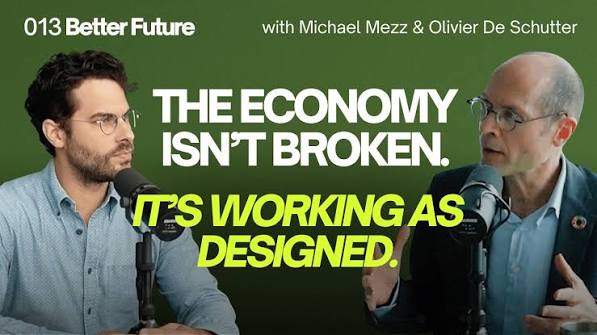
De Schutter argues for a new economic system to address climate change and economic inequality. To accomplish this, people should have broader democratic participation in the decisions made in workplaces, corporations, and the markets themselves. Democracy should not stop at the ballot box.
Critics might counter De Schutter by pointing out that the economy is already democratized with voter participation in elections and people making responsible consumer choices that can shape market outcomes. Take for instance the widespread consumer boycotts of Target over the elimination of its DEI programs in January 2025. In that same quarter, Target revenue and sales declined (Brown, 2025a), profits fell by 36% in year-over-year comparisons (Brown, 2025b), and by mid-2025, Target’s stock dipped by more than 30 percent (Sustainable Business Magazine, 2025).
Unarguably, the boycott had an impressive effect on the corporation and investors. The problem is, however, that consumer boycotts are temporary coercive tactics that apply pressure by reducing a bad actor’s revenue until it capitulates. Boycotts do not create durable mechanisms for public participation in strategic decision-making. If the latter had occurred, Target’s employees would have had a formal say in DEI’s fate.
De Schutter makes the case that a democratized economy is inclusive in its design. To make a shift in an economic design requires dissecting the economic thinking undergirding today’s economic thought.

Four Critiques of Capitalist Scaffolding
De Schutter critiques Capitalism, proposing we redefine poverty, we rethink growth-machine ideologies, we remove public goods from the commercial market, and we get money out of politics.
1. Redefine extreme poverty. The narrative that “capitalism ended poverty” is built around fraudulent measurements of the international poverty line. Introduced in 1990, World Bank economists determined that $1/day was sufficient to meet basic human needs (Thomas, n.d.), based on 1985 prices based on the purchasing power of the world’s poorest nations. Basic needs were determined to be a subsistence calorie diet. Far from a real standard of decent living or even wellbeing, the measure was fundamentally wrong, says De Schutter. Swap in $8.20/day and roughly 45% of the world is poor.
2. Interrogate Growth Paradigms. De Schutter points out that the growth machine, contrary to hegemonic discourse in North America, does not lift all boats. For example, automation and productivity tools, such as today’s AI models, are growth mechanisms that risk destroying more jobs than they create. For example, automation and productivity tools, such as today’s AI models, are growth mechanisms that may be destroying more jobs than they create (Murray, 2026), and AI’s erosion of critical cognitive skills (Cash et al., 2026) could also affect workers.
3. Commodification Manufactures Scarcity. Healthcare, education, and care work were once freely available to many people. Privatization has forced more people to earn higher incomes simply to maintain their standard of living as costs rise faster than wages. On paper, this increase in economic activity appears to be growth. In practice, people work harder, often to the point of exhaustion and burnout.
4. Get Money Out of Politics. To break the present emphasis on growth requires a shift in who has political power. Today, it’s widely understood that economic power buys political influence. Modern corporations (and their billionaire owners) have become so powerful, they can challenge the authority of the state. They rewrite the rules to favor themselves. Referencing Zingales’s 2017 paper in the Journal of Economic Perspectives, De Schutter evokes the “cycle of Medici” to describe corporations’ power to influence politics and the resulting reinforced cycle perpetuating a rise in economic and political power of the elite.
But what does democratizing the economy really mean in reality? For answers, De Schutter points us to the Social Solidarity Economy (SSE).
