
The following is Part 2 of a two-part discourse by David Southgate during the South Puerto Rico Community Summit. While Part 1 detailed the reality of “slow violence” and historical planning failures, this section outlines the transdisciplinary framework we used to empower the residents of Ponce as the primary architects of their own resilience.
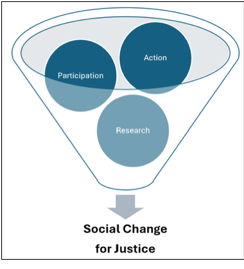
A theory of change based on Critical Participatory Action Research underpinned the VIDA Costera project. Un Nuevo Amanecer set out to foster a communicative space for residents to self-organize and gain mutual understanding regarding their experiences and perceptions about their neighborhoods (the participation aspect). We coupled that with agreements about how to treat each other through words and deeds, as well as to think relationally about their neighborhoods and nature (the action aspect). Finally, we sought to foster critical self-reflection in repeated cycles of planning, acting, observing, and reflection in active exercises geared to urban/coastal nature-based solutions to climate change (the research aspect). The plan tackled social exclusion by prioritizing the voices of groups historically left out of planning.
Theory of Change: Critical Participatory Action Research
The foundation of the VIDA Costera project was a theory of change informed by Critical Participatory Action Research (Kimmes et al. 2014).
Participation: Central to this approach was the creation of a communicative space through the Un Nuevo Amanecer initiative, wherein we encouraged residents to self-organize and develop a shared understanding of their own experiences and perceptions of their neighborhoods. This participatory process emphasized the importance of open dialogue and active engagement among community members.
Action: Coproducing clear agreements about how residents wanted to interact with one another, both in language and action, strengthened their participation. This fostered a sense of mutual respect and encouraged community members to think relationally about their neighborhoods, each other, and the surrounding natural environment. Through this, we sought to empower participants to take deliberate action within their communities.
Research: The project also prioritized critical self-reflection, embedding it with initial consciousness raising training, and later within ongoing cycles of planning, acting, observing, and reflecting. The project plan included cycles of active exercises focusing on developing urban and coastal nature-based solutions to address climate change. Not surprisingly, conversations also included solutions that had little to do with nature. Through this iterative process, residents engaged deeply with the challenges and possibilities facing their neighborhoods, as well as engaged their distinct neighborhoods in that process.
Social Change for Justice: The plan that emerged from this work aimed to address the injustices of exclusion from traditional planning processes. By centering decision-making on those who have been historically marginalized, the VIDA Costera project sought to create more equitable and just outcomes for the community.
And that was our model of change, or theory of change, underpinning the project.
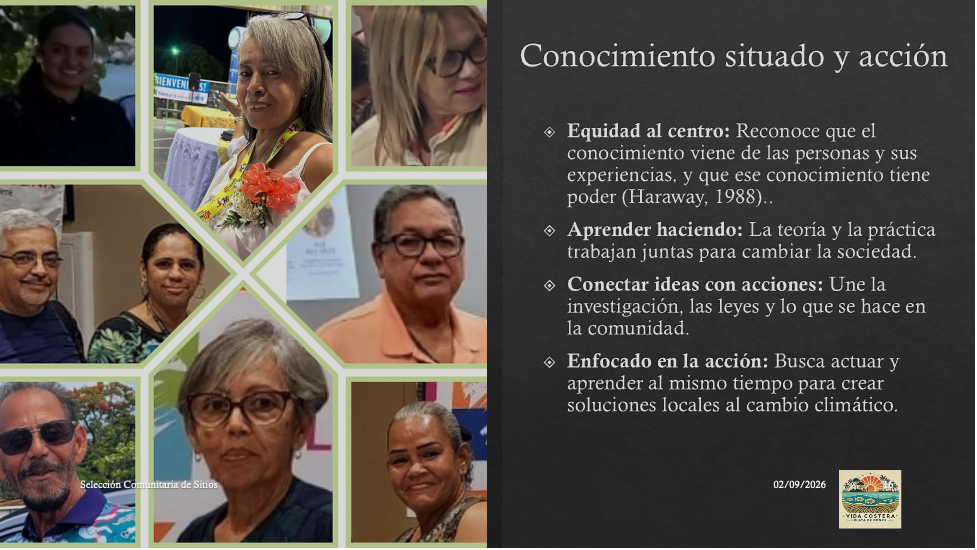
We supported residents with a coalition of experts—academics and government officials, along with a technical team who served as professional service providers for the resident cohort. We converted our residents into “mini-planners” charged with making inquiries in their own neighborhoods using the techniques and the criteria that they themselves determined.
Implementing a Trauma-Informed Approach
To implement this framework, the project intentionally adopted a trauma-informed approach, attempting to embody a sense of care and understanding to the best of everyone’s abilities. This was particularly important because many of the residents, as well as members of the technical team, had experienced challenging circumstances, including the impacts of natural disasters. By acknowledging these experiences, the project aimed to create a supportive environment for all participants.
In practice, several key principles reflected the approach:
- Respect Local Knowledge and Priorities: The process prioritized the perspectives and needs of the community, valuing their local knowledge and lived experiences over external or global capital interests.
- Community-Guided Investment: Rather than focusing solely on infrastructure, the project invested in processes that the community itself selected and learned, ensuring that local voices shaped the direction and outcomes of the work.
- Transparency and Accountability: The work committed to transparency and accountability, fostering trust and open communication among all participants and the project team.
Thank you very much for your attention. I hope you learned something useful today. I have some questions for us to consider during lunch:
- What makes adaptation efforts truly community-led?
- How can planners work ethically with communities that have been historically displaced?
- What role can you play in supporting just adaptation to climate change?
