
Carmen didn’t just save one thousand jobs; she built a bank.
When a severe austerity policy at her husband’s employer threatened to slash her family’s income—along with that of more than 1,000 of his colleagues, Carmen (not her real name), a community activist in Playa de Ponce, launched a crusade. She organized, spoke out to the press, and ultimately succeeded: the large Ponce employer reinstated full-time status for everyone involved. On the surface, this appears to be a classic triumph of labor justice. Henry George himself might have applauded Carmen’s actions as a valiant struggle against the grinding poverty that forces people to accept less than they are worth. But a deeper reading reveals economic lessons that may resonate with Georgists.
I learned of Carmen’s sacrifice and victory during an informal exchange following a recent Un Nuevo Amanecer meeting about reestablishing UNA’s vivero, which is a nursery to nurture seedlings for nature-based projects in the shoreline communities of Puerto Rico’s Bay of Ponce and Playa de Ponce urban neighborhoods.
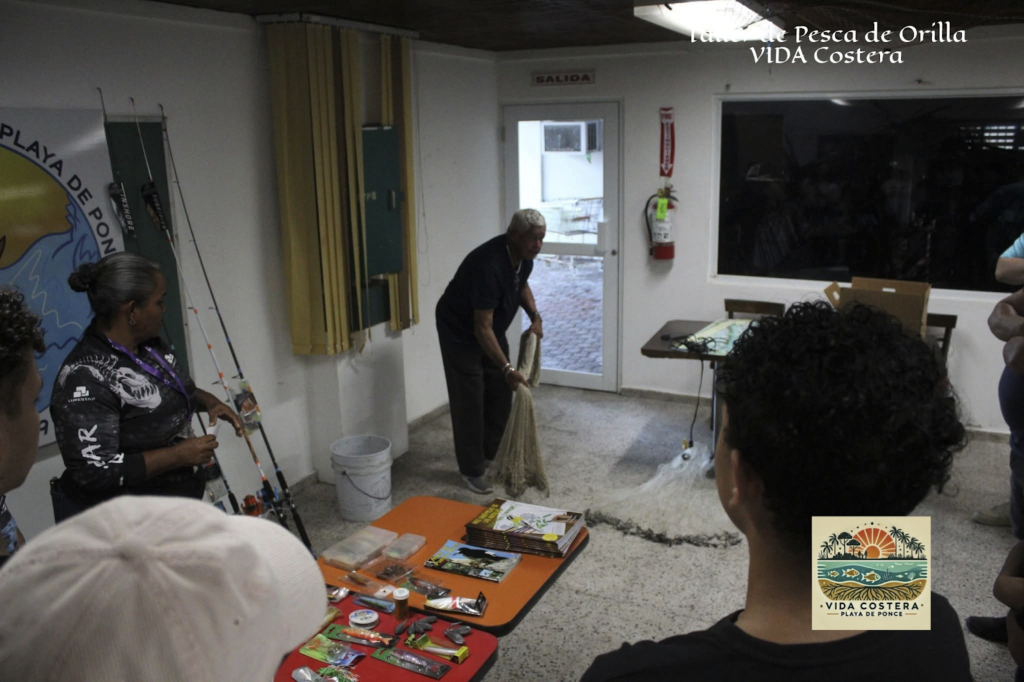
Caption: Community leader Hild Carrión teaches Playa de Ponce youth fishing techniques during UNA’s VIDA Costera Taller de Pesca de Orilla, a collaboration with Villa Pesquera fishing village. Photo courtesy Evelyn Thillet, Playera, VIDA Costera cohort member and communications.
When Carmen reflected on her victory, she said something that reminded me of Pierre Bourdieu’s sociological economic theory of the “economy of practices:” “People who got back their full-time jobs respond to my petitions for our community,” Carmen said, expressing her contentment over the social support network she can now mobilize to address pressing needs in Playa de Ponce.
Carmen’s seemingly contradictory mix of altruism and subsequent leverage shows exactly where traditional economic analysis falls short. Those of us steeped in the political economy of Henry George are trained to look for “rent”—unearned income derived from land and neighborhood improvements. We focus on how the enclosure of the natural world strips workers of their independence, forcing them to compete for wages. While Georgism perfectly explains the vulnerability of these workers, it does not fully account for the mechanisms of reciprocal exchange.
To understand Carmen’s power, we must look beyond the traditions of classical political economy to sociological political economist Pierre Bourdieu.
Non-Instrumental Good Deeds Produce Delayed Reciprocal Exchanges
Bourdieu contributes to our understanding of value by rejecting “economism,” the idea that people act rationally when cash changes hands. He argues instead that a strict “economy of practices” governs social life; good deeds function as capital when they are perceived as altruistic. In this view, Carmen’s advocacy for her husband and coworkers was a massive act of economic exchange. Her energy to save those full-time jobs resulted in an unspoken social debt.
Bourdieu would argue that the core of reciprocity is kind acts with no expectation attached. The non-instrumentality creates a debt. The currency is favors. The delayed repayment for a good deed lets people overlook the idea that every good deed deserves another. In communities where favors are valued, paying back immediately—giving $20 for helping to move a couch, for example, undermines relationships built on generosity.
This contrasts with a standard market transaction, where the exchange is immediate and transparent: I give you $12, and you give me a sandwich. The books are balanced instantly, and we owe each other nothing.
Importantly, I detected no sense of strategic or cultivated self-interest as I listened to Carmen describe her activist motivation to help others. At the same time, her account of the satisfaction she felt when that same group of employees later responded to her small requests for advice or support suggests that these actions generated reciprocal obligations. The result was a social structure that operated without overt coercion, deriving its power from durable social bonds rather than explicit calculation.
The Debt That Binds
This brings us to a crucial distinction between the world Henry George wanted to build and the world Carmen currently inhabits. Bourdieu posits that every social interaction is an economic exchange, even if no money changes hands. The social obligation from gifting yields power to the gifter, a “gentle violence.” (Bourdieu, dk) that contrasts with the structural domination of modern capitalism. In pre-capitalist societies, or in modern communities where the state has failed, selfless generosity (within one’s means) not only feels good, it may be returned someday as a favor.
A key point for modern Georgists: all social interactions are forms of economic exchange. Georgists focus on structural remedies, arguing for taxing land values as the mechanism for a free society. Carmen’s story reminds us that until that structural justice is achieved, some communities will rely on symbolic capital, earned through sacrifice, repaid in homage. To recognize this invisible economy is to more fully grasp how communities can cope in adaptive ways to structural inequalities.
References:
Bourdieu, P. (1977). Outline of a Theory of Practice (E. Gellner, J. Goody, S. Gudeman, M. Herzfeld, & J. Parry, Eds.; R. Nice, Trans.; 28th ed.). University of Cambridge. https://dokumen.pub/outline-of-a-theory-of-practice-cambridge-studies-in-social-and-cultural-anthropology-9780521291644.html
Marx, K. (1867). Capital Vol. I – Chapter Twenty-Six. In Economic Manuscripts. https://www.marxists.org/archive/marx/works/1867-c1/ch26.htm
