
Visitors to Puerto Rico’s south coast inevitably come across the PR-127 former petrochemical corridor, among the world’s largest petroleum complexes in the 1960s. Commonly referred to as La CORCO—a name derived from the anchor industry, the Commonwealth Oil Refining Company, the zone encompasses approximately 3,500 acres. These lands are not solely associated with CORCO, however; they are privately held and split among around 42 different entities that operated within the complex. Even 40 years after their closure, this area remains a site of ongoing tensions, balancing nature versus industry, economic growth versus public and environmental health, and laissez-faire policy versus a proactive approach to land restoration.
These tensions are rising because of US seizure of Venezuelan Oil. Peñuelas, Puerto Rico is just 455 miles from Cabo San Román, Venezuela. A proposal to the acting US President has emerged to reactivate the PR-127 Corridor to position the barren landscape as processing hub for Venezuelan crude.
In the following paragraphs, I apply a Georgist framework to the area as a means of questioning the environmental justice implications of such a proposal. But first, let us imagine driving through the area.
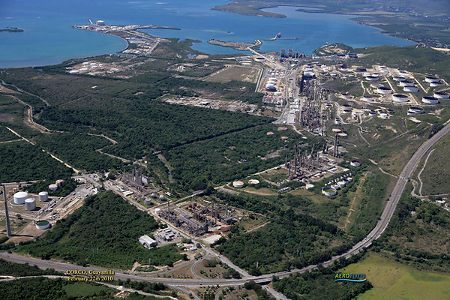
To the eye, the PR-127 petrochemical corridor showcases a rich ecology, the stuff of tourist brochures. The backdrop is an expansive Caribbean Sea and the Guayanilla Bay, its deep blue waters and mangroves providing an ecosystem for an abundance of Puerto Rico’s Antillean Manatees. But if you just turn your head a few degrees inland, the view shifts from paradise to something out of a post-apocalyptic movie set: massive rusting petroleum distillation towers, steal transmission lines, and tank farms stretching out like crop circles.
You might see industrial ponds completely overgrown with weeds, as well as legacy industries such as CORCO, which continues to operate, as does Puerto Rican Electric Power Authority’s Costa Sur, with capacity to sometime generate 990 MW. You would also see a smattering of new industries, such as Masterpaints’ Puerto Rico acrylic paints factory whose processes are 100% solar-powered, as well as Eco-Electrica, an LNG gas-to-energy plant producing an estimated 540 MW.
This is the PR-127 corridor, a landscape of industrial ghosts next to more eco-friendly companies, set amid immense natural assets, the deep water port, the bay, and people’s homes and schools
Some 57 percent of the area’s 11,000 residents live in dire poverty and many have long-standing health burdens, likely due in part to environmental exposures to toxins in the air, soil, and water. For these 11,000 people living in the shadows of shuttered hydro-carbon derivative industries in the coastal municipalities of Penuelas and Guayanilla, the hulking industrial remains are a daily reminder of area’s 1980s economic collapse. For many, the PR-127 corridor is a constant source of anxiety about what exactly is leaking into their soil, water, and air.
The calls for reactivating the former petrochemical zone of Peñuelas and Guayanilla to process Venezuelan crude oil under U.S. strategic control is framed as a patriotic opportunity to strengthen American energy security while creating thousands of jobs.
Yet this promise of economic revival overlooks important realities: the land is not empty, the past is not clean, and perhaps most importantly, the community has already envisioned a future for those sites, one that embraces a type of environmental justice that 19th century economic philosopher Henry George might have embraced.
The Georgist Lens: Who Owns the Land, and Who Pays the Cost?
Henry George argued that land and natural resources are part of the common inheritance of humanity. When private actors extract wealth from land without compensating the public for its use, or worse, when they degrade it, they effectively appropriate what belongs to all.
What happened along PR-127 is a textbook case of this.
Petrochemical industries generated enormous private profits during their peak years. When global market conditions shifted, many facilities closed or downsized, leaving contamination behind. The economic rents were privatized; the environmental liabilities were socialized. And the community became the involuntary custodian of abandoned industrial risk.
The new proposal to reactivate the former petrochemical zone with Venezuelan crude oil speaks of jobs, GDP, and national security. What it does not meaningfully address is the full cost of remediation, the unresolved liabilities, or the lived experience of neighboring residents who continue to face cumulative environmental burdens.
From a Georgist perspective, any redevelopment that does not begin with strict application of “polluter pays” principles merely repeat the cycle in a landscape that has been shaped by extraction.
The Community Did the Work
The irony is that the region does not lack vision. Between 2010 and 2019, I won nearly $2 million in EPA funding and other technical support, enabling the regional socio-economic development agency to contract the financial and technical resources to work with community on a reuse plan for the corridor. Community leaders participated deeply in site assessments. Our experts conducted environmental due diligence. And a team from the Council of Finance Development Agencies produced a roadmap for concerted public-private action, Puerto Rico 127 Corridor: Roadmap to Redevelopment, prepared for the Puerto Rico Department of Economic Development and Commerce and Desarrollo Integral del Sur, Inc..
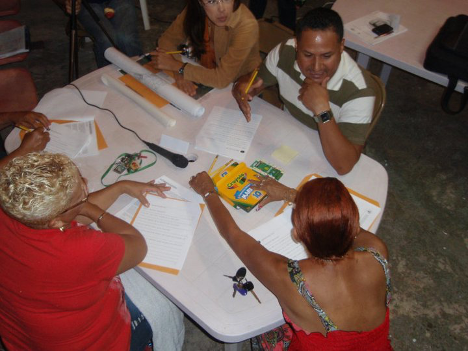
What emerged was the community’s vision for an Eco-Industrial Zone. Instead of the contaminated and abandoned industrial landscape of the PR 127 corridor, the community wanted the sites redeveloped into a sustainable economic hub. Specifically, the community-driven master reuse plan envisioned a zone that featured:
- Utility-scale photovoltaic (solar) energy.
- A biofuel innovation hub.
- Resource recovery facilities.
- An industrial park powered by renewable energy.
Ultimately, this vision aimed to tackle the region’s pressing sustainability challenges, among them high energy prices and solid waste issues that continue to this day, while simultaneously creating jobs to combat the area’s prolonged 20% unemployment rate.
The Master Plan also underscored that redeveloping 3,500 acres of underutilized environmentally compromised properties, as well as severely degraded industrial infrastructure.
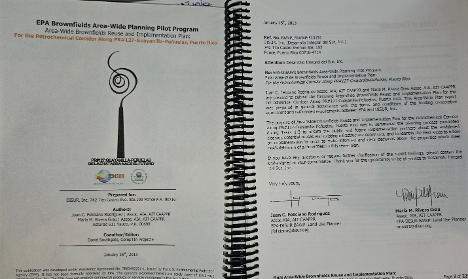
In the mid-2010s, the team completed 11 environmental assessments encompassing 1,800 acres of corridor. These studies revealed likely contamination from petroleum-related pollutants, PCBs, asbestos, lead-based paint, and underground storage tanks.
But it’s not just the contamination that is at issue. Following Hurricane Maria, it became clear that the former petrochemical zone still played a critical role in petroleum distribution for south Puerto Rico. It was providing gas and diesel for emergency generators during the massive blackout. At issue was the infrastructure in the surrounding area.
The most viable alternative identified was not a return to fossil fuel dependency, but a transition toward a diversified Eco-Industrial Zone, integrating renewable energy, resource recovery, and modern industrial innovation. Through policy analysis, I proposed the creation of a Land Redevelopment Authority (LRA), an administrative mechanism to steward this transition with adequate legal powers to acquire, remediate, and reposition contaminated land for productive reuse. An LRA would provide a structured pragmatism grounded in law, environmental science, and economic justice.
The roadmap to redevelopment recognized three realities not ideologically opposed to industry:
- The contamination must be precisely measured (Phase II assessments).
- Non-cooperative landowners must not be allowed to stall remediation.
- Public funds must not absorb costs that rightly belong to legacy polluters.
Energy Security Without Community Security Is Hollow
The CORCO reactivation proposal frames the moment geopolitically: redirecting Venezuelan crude, countering China, strengthening U.S. energy independence. But energy security cannot be divorced from community security.
The residents of Peñuelas and Guayanilla are not abstract beneficiaries of macroeconomic strategy. They are neighbors who have experienced refinery closures, ash controversies, hurricanes, fiscal crisis, and chronic infrastructure fragility. Many live within the cumulative exposure zones of multiple industrial facilities.
To speak of reactivation without first speaking of cumulative burden is to erase them.
A Georgist approach would ask:
- What is the full environmental rent owed for decades of degradation?
- Who captures the future land value increase if federal investment returns?
- Will increased land values accrue privately, or will they be recaptured for public benefit?
- Are we locking the region into another half-century of fossil dependence, or positioning it for transition?
The land remembers what happened there. So do the people. Reviving the PR-127 Corridor without acknowledging the problem of private extraction, public exposure, and deferred polluter accountability threatens to repeat past and ongoing harms. The question is whether, this time, redevelopment can be a vehicle to ensure that the community finally receives justice.
