
Opportunities for climate adaptation can emerge unexpectedly, prompting communities and their institutions to explore a maze of complicated decisions. As a board member for the CBO Un Nuevo Amanecer, Inc. (UNA), I’ve learned to embrace these moments through rigorous analysis.
The challenge lies in balancing community responsiveness with responsible organizational leadership. Sometimes, this requires us to quickly comprehend complex legal instruments for land ownership and manage power differentials during negotiations. I share the following to help other organizations navigate similar complex land deals.
The Unexpected Opportunity
The opportunity arose from UNA’s February 2025 invitation to a foreign-owned company operating in Puerto Rico. We invited them to join UNA’s VIDA Costera coastal resilience community-led planning effort because the corporation owns coastal parcels crucial for buffering storm surge and stemming erosion.
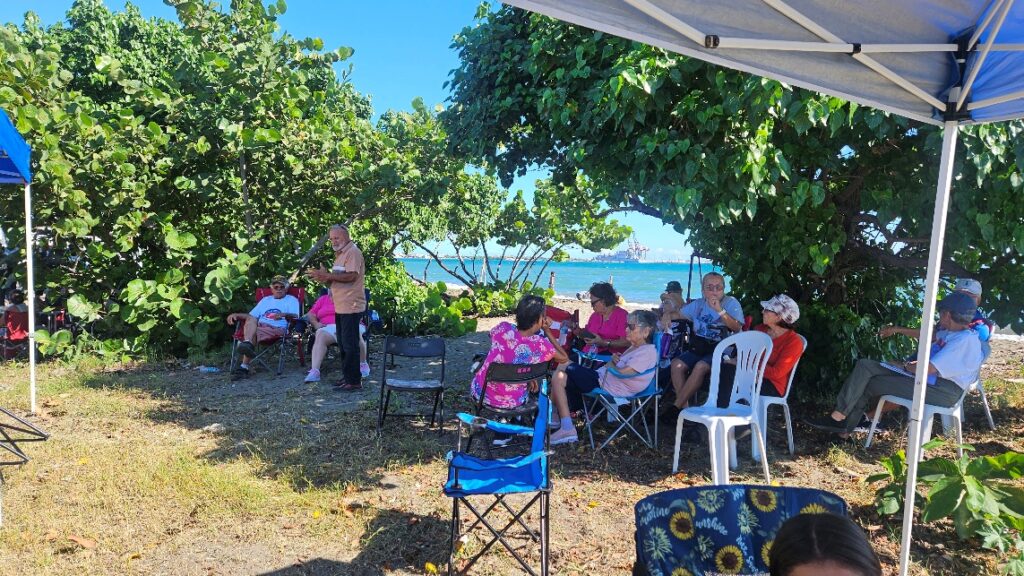
Neighbors gather at a vacant lot for a community barbeque planned by UNA’s VIDA Costera project.
These parcels are central to neighborhood-level climate threats. Past human development eliminated the sand dunes and vegetation that once protected inland homes in this sector of La Playa. Today, erosion from wave action, storms, and post-earthquake tectonic subsidence is eating away the shoreline. The community envisions a functioning transitional habitat along a continuous corridor of restored dunes, native plantings, public access, and coastal species. It will all require technical knowledge, funding, and labor.
We were hopeful the owner would participate in our efforts, but four months after our invitation, the owner returned to us with a surprising and encouraging proposal: donating their lands for nature conservation via a permanent land tenure arrangement. A conservation easement is a voluntary, permanent land-use restriction that legally binds institutions to protect land based on its natural, historic, cultural, or agricultural value. For the existing landowner in Puerto Rico, such a donation could qualify them for a significant tax credit.
The Need for Structured Analysis
While UNA volunteers and technical experts have informally stewarded public lands for five years—starting with cleanups and tree plantings—a formal conservation easement was new terrain for our all-volunteer board. We needed to grasp the complex regulations, leverage our organizational strengths, understand the landholder’s motivations, and use all this information to guide our negotiation strategy.
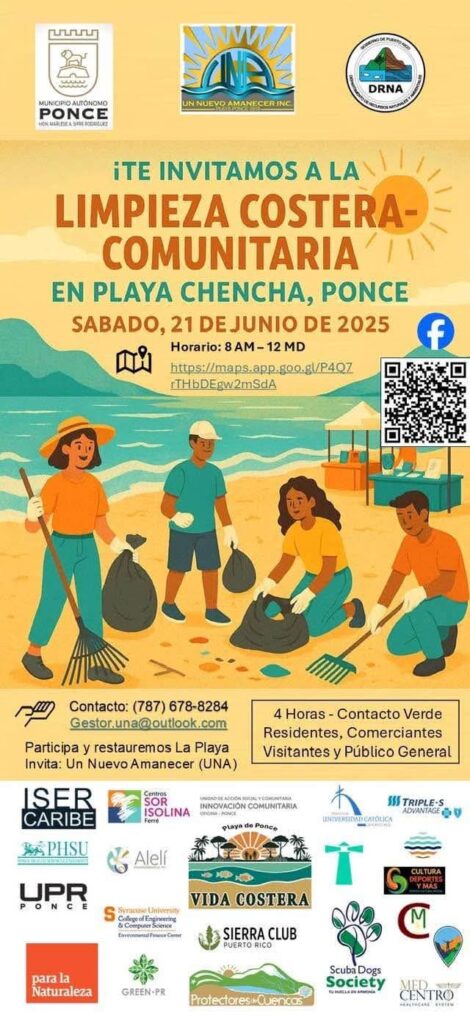
A recent promotion illustrates just one of Un Nuevo Amanecer’s community land stewardship activities with local volunteers and institutional collaborators. .
This is precisely why a Decision Matrix became an essential tool for UNA’s Board of Directors to identify and navigate risks. What began as a simple spreadsheet evolved into a structured framework for clarifying options, surfacing unknowns, and identifying exposures. The matrix sparked excellent discussions on how our small nonprofit could confidently engage in a complex land transaction with a large private entity.
Why a Decision Matrix Matters
Community organizations are often deeply driven by vision and values. A true test of an organization’s resolve is its ability to comprehend the legal, financial, ecological, and reputational implications of an undertaking that could set the organization and the communities it serves on a decades-long path. Adaptation decisions like land stewardship arrangements can commit human and financial resources for a timeframe that will likely outlive current leadership.
A Decision Matrix helps leadership conduct crucial soul-searching by answering key questions:
- What do we know and what do we not know?
- What assumptions are driving the conversation?
- What hidden risks or costs might exist?
- What conditions must be met before moving forward?
- How does each scenario affect the community, the organization, and the long-term resilience strategy?
Having these answers reduces confusion, clarifies pathways, and identifies deal-breakers. Decisions that are grounded, deliberate, and transparent protect the community’s best interests and safeguard the organization from pressure to act prematurely.
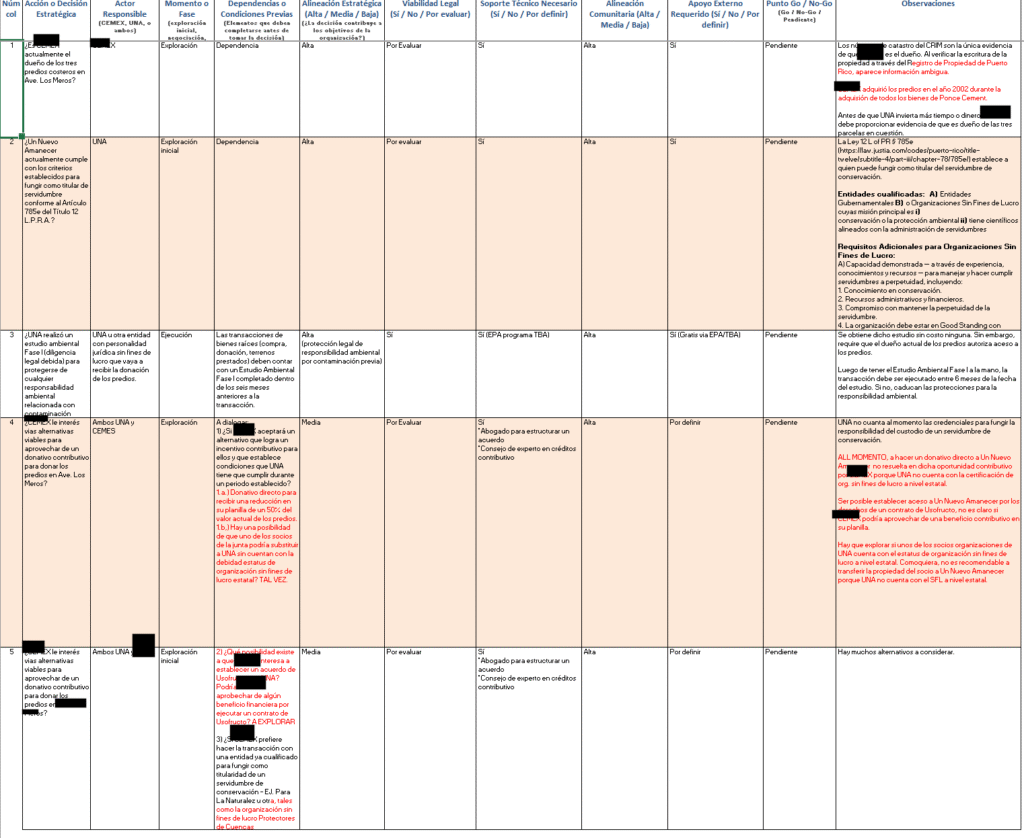
UNA’s redacted decision matrix reflects ongoing processes and go/no-go decisions.
Using the Decision Matrix to Navigate Complexity
When UNA entered preliminary conversations, the board quickly realized the potentially transformative opportunity came with many unanswered questions. The Decision Matrix organized these uncertainties into categories:
- Title and Ownership: What is the condition of the title? Are there encumbrances or unresolved issues? Would accepting the land create new liabilities?
- Environmental Conditions: Has the land been previously disturbed or contaminated? Would accepting the donation be conditioned upon our ability to complete environmental assessments?
- Financial and Capacity: What would be the long-term cost to steward, maintain, and conserve the land? Does UNA have the human capacity for a long-term easement? Should a partner entity, like a land trust, take the lead?
- Community and Climate Benefit: How would conservation protect residents from flooding or heat? What nature-based solutions are feasible on sandy, erosion-prone land?
- Negotiation Strategy: What additional information is required from the landholder? Which questions need expert legal or ecological analysis? What are UNA’s non-negotiable conditions?
Every unresolved question, new discovery, or shifting scenario was immediately added to the matrix—highlighted in red to keep the board’s attention focused on uncertainties. The result was a discussion focused on facts, not speculation, and systematic board assessment that created clarity rather than overwhelming people.
A Tool for Trust and Replication
Legitimacy flows from transparency. For a nonprofit like UNA, decisions about land, funding, and partnerships carry long-term consequences for the residents of La Playa. Residents are more likely to trust and support these decisions if the organization openly shares the reasoning, risks, and benefits under consideration.
The Decision Matrix becomes a vital vehicle for future discussions with residents, demonstrating that choices are informed, careful, and truly aligned with community interests. It provides a structured way to show the logic behind each choice and the conditions necessary to safeguard the organization and the neighborhoods we serve. Furthermore, it prepares the board for informed conversations with external teammates: lawyers, potential funders, partners, and government agencies.
Many small nonprofits face dilemmas like opportunity vs. capacity, climate urgency vs. due diligence, and community benefit vs. organizational risk. The core dilemma in this scenario—securing coastal land for community resilience is entangled with serious organizational risks. The Decision Matrix bring this entanglement into sharp focus. It illuminates the tension between what the organization hopes to do and what it must responsibly consider to avoid placing itself and the community at risk.
For other CBOs exploring adaptation opportunities: Remember that your mission is not just about seizing an opportunity, but about sustaining your organization and protecting your community over the long term. The Decision Matrix transforms a hopeful but daunting challenge into a manageable, deliberate process.
While UNA is currently in the crucial phase of negotiating an MOU that will define a common path between the two parties, we are also confirming the feasibility of this land donation. The framework I built is helping to guide the process; however our core lesson remains clear: Rigorous, systematic analysis is not an obstacle to progress; it is the foundation of enduring community resilience.
