
The night I got my first lesson in Colombian property law, I was seated at an Italian restaurant on the edge of Provenza — Medellín’s famously raucous party district. On the street outside, Provenza was doing what Provenza does — karaoke, clinking glasses, the low roar of a neighborhood fully alive. Among our dinner companions was a local property attorney, whom I asked out of idle curiosity: “How are property rights in Colombia?” His answer brought out the geek in me.
“Private ownership, but shared collective benefit,” he said.
For someone trained in U.S. community development theory, those six words sounded unmistakably like Henry George. Back at my hotel, I started digging. What I found was a living Georgist experiment.
What I Saw on the Ground
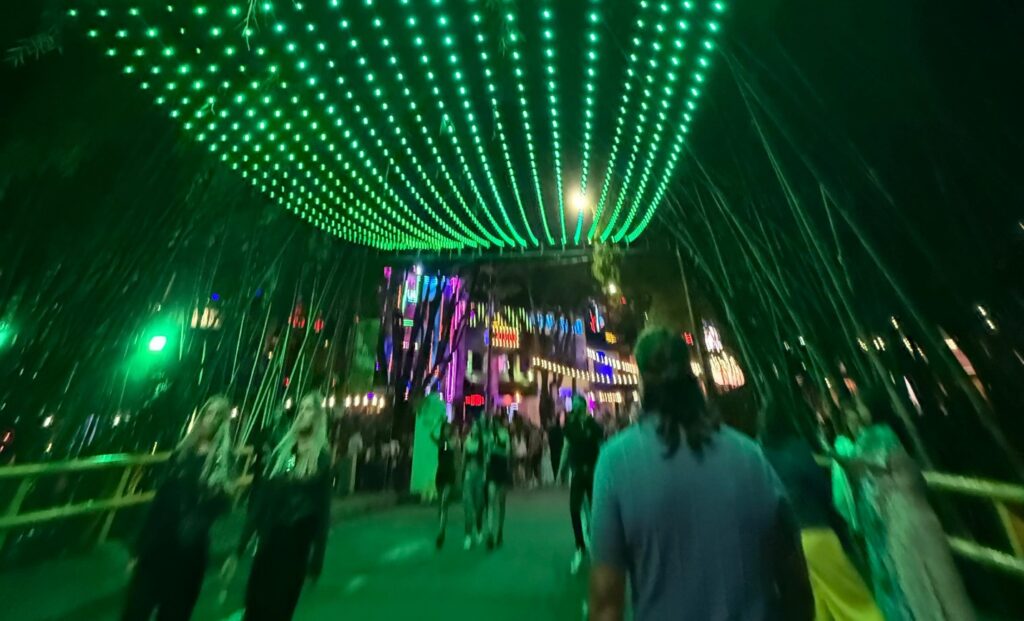
Before the research, there was the tourist’s eye. In Provenza, I was watching the Área de Revitalización Económica (ARE) at work without knowing its name — 247 businesses animating pedestrian streetscapes, 1,100 jobs recovered post-pandemic, between 19,000 and 22,000 visitors a week (Echavarría, 2022). In 2022, Time Out had named it one of the world’s 33 coolest streets. It still is.
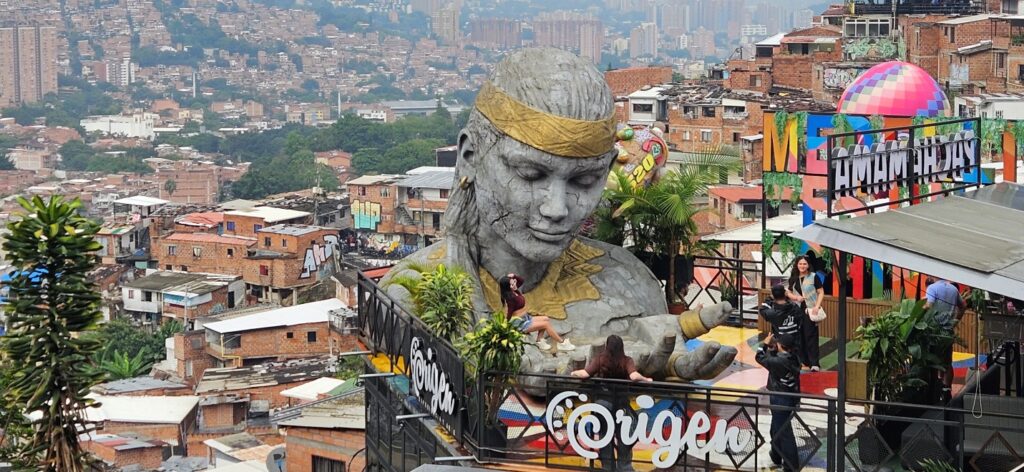
Then there was Comuna 13 — a decade ago one of Medellín’s most violent informal settlements, a hillside of unregistered construction where the state’s reach historically meant only military incursion. Award-winning urban innovation has transformed Comuna 13 into a cascade of tropical murals, improvised live Afro-Latino hip-hop, open-air food stalls, and outdoor escalators ferrying visitors up slopes once dominated by narco-traffic and murder. The transformation was accomplished via the Proyecto Urbano Integral (PUI), which approached plazas, stairways, and circulation as essential infrastructure rather than secondary amenities. This method integrated social engagement into the physical intervention itself (García Ferrari et al., 2018; Maclean, 2015).
Trained in U.S. community development, I arrived in Medellín expecting the familiar pattern of injustice: governments identify blight, eliminate it, then attract investment — a logic that, as decades of evidence show, displaces the very people it claims to help. What I encountered was structurally different.
The Constitutional Iceberg
The lawyer’s offhand remark pointed, I discovered, to a constitutional architecture nearly a century in the making. Colombia’s 1936 reform introduced the función social de la propiedad (the social function of property), establishing that private ownership carries public obligations. The 1991 Constitution deepened this with Articles 58, 63, and 82, collectively affirming that when public zoning actions increase the development value of private land, the public is entitled to recover that increment (Doebele, 1998). Article 82’s plusvalía established the legal principle that socially created value belongs to society.
Law 388 of 1997 operationalized this. It required all Colombian municipalities to develop master plans and authorized them to capture 30 to 50 percent of the increased land values generated by the new zoning, assessed per square meter by the independent Agustín Codazzi Geographical Institute (Doebele, 1998). As Rojas and Smolka (1998) noted, apart from Taiwan, Colombia was among the very few countries to directly incorporate Georgist principles into national legislation — operationalizing George’s premise that “the public has a moral right to recover socially created values.”
These contemporary laws followed Colombia’s tradition of contribución de valorización — a betterment levy on properties that benefit from public works. Colombia collected on the levy since 1921 and in Medellín since 1938, predating Law 388 by nearly six decades (Ochoa, 2013). By 1968, the levy accounted for approximately 45% of Medellín’s local revenues (Smolka, 2013). Georgism was already paying Medellín’s bills half a century before the 1991 Constitution enshrined LVT.
Medellín’s ARE program, formalized by Mayoral Decree #667 of 2022, is the latest evolution of this logic. ARE zones are administered by non-profit associations of merchants and civic organizations, financed through the Aprovechamiento Económico del Espacio Público (AEEP) — the statutory mechanism that operationalizes Article 82’s principle that commercial use of public space must generate a public return (Alcaldía de Medellín, 2022). In Provenza alone, over US$ 257,876 has been reinvested in public space maintenance (Echavarría, 2022). The through-line runs from George to the 1936 reform in Colombia, through Colombia’s 1991 Constitution and Law 388, arriving finally at a merchant cooperative paying into a communal fund on one of the world’s coolest streets.
The Contrast Between US and Colombian Logics
Back in the U.S., the logic runs in the opposite direction — and its targets have never been racially neutral. Fullilove (2004/2024) documented how U.S. urban renewal and blight elimination programs destroyed approximately 1,600 African American districts beginning in 1949, inflicting intergenerational health, economic, and political harms. French-Marcelin (2015) showed that New Orleans administrators weaponized “blight” by using metrics explicitly correlated with race to redirect federal Community Development Block Grants away from antipoverty work and toward middle-class revitalization. The displacement was the instrument of racism. We see that logic replicated in contemporary climate displacement in Puerto Rico (see my related writing on land dispossession and unjust taxation).
To be fair: land value capture is not automatically equitable. Wolf-Powers (2024) has shown that instruments like Tax Increment Financing can deliver publicly generated wealth to already-affluent parties while accelerating price escalation that harms low-income residents. But what distinguishes the design of Medellín’s ARE and PUI frameworks is that non-profit civic associations govern the reinvestment, directing it explicitly toward public space and commons infrastructure — embedded in a constitutional tradition that treats land as a social resource rather than a commodity to be maximized (García Ferrari et al., 2018).
What One Conversation in Medellín Taught Me
The casual remark of a Medellín property lawyer over cocktails and dessert, at the fringe of one of the world’s great street parties, opened a doorway into one of the most significant implementations of Georgist principles anywhere on earth. Colombia built George’s ideas into its fiscal DNA — levy by levy, then into its constitution and municipal code. Provenza’s economic revitalization occurred because, for nearly 90 years, Colombian law required that when a city increased the value of its land, it keep some of the value it created.
In George’s own terms, that’s justice.
References
Alcaldía de Medellín. (2023). Informe de empalme: Medellín Futuro 2020–2023. Departamento Administrativo de Planeación. https://www.medellin.gov.co/es/wp-content/uploads/2023/12/VF_INFORME-EMPALME-DAP.pdf
Aguirre, D. C. (2024). Provenza se posiciona como referente de renovación de la vida urbana para 25 puntos de Medellín. Alcaldía de Medellín. https://www.medellin.gov.co/es/sala-de-prensa/noticias/provenza-se-posiciona-como-referente-de-renovacion-de-la-vida-urbana-para-25-puntos-de-medellin/
BBC News. (2013, March 1). Colombia’s Medellín named “most innovative city.” https://www.bbc.com/news/world-latin-america-21638308
Doebele, W. A. (1998). The recovery of ‘socially created’ land values in Colombia. Land Lines, 10(4), 5–7. https://www.lincolninst.edu/app/uploads/2024/04/403_linc_landlines207.98.pdf
Echavarría, A. (2022). El alcalde Daniel Quintero Calle oficializó el decreto que habilita las Áreas de Revitalización Económica (ARE). Alcaldía de Medellín. https://www.medellin.gov.co/es/sala-de-prensa/noticias/el-alcalde-daniel-quintero-calle-oficializo-el-decreto-que-habilita-las-areas-de-revitalizacion-economica-are-para-potenciar-el-uso-del-espacio-publico/
French-Marcelin, M. (2015). If you blight it, they will come: Moynihan, New Orleans, and the making of the gentrification economy. Nonsite.org, (17). https://nonsite.org/if-you-blight-it-they-will-come/
Fullilove, M. T. (2004/2024). Root shock: How tearing up city neighborhoods hurts America, and what we can do about it (20th anniversary ed.). New Village Press.
García Ferrari, S., Smith, H., Coupé, F., & Rivera, H. (2018). City profile: Medellín. Cities, 74, 354–364. https://doi.org/10.1016/j.cities.2017.12.011
Maclean, K. (2015). The miracle? Social urbanism. In Social urbanism and the politics of violence: The Medellín miracle (pp. 53–77). Palgrave Pivot. https://doi.org/10.1057/9781137397362_4
Ochoa, O. B. (2013). Contribución de valorización o mejoras en Colombia: Análisis de la experiencia colombiana. Lincoln Institute of Land Policy. https://www.lincolninst.edu/app/uploads/2024/04/borrero-wp14ob1sp-full_0.pdf
Rojas, F., & Smolka, M. O. (1998). New Colombian law implements value capture. Landlines: Newsletter of the Lincoln Institute of Land Policy, 10(2), 8. https://www.lincolninst.edu/app/uploads/2024/04/422_linc_landlines203.98.pdf
Smolka, M. O. (2013). Implementing value capture in Latin America: Policies and tools for urban development. Lincoln Institute of Land Policy. https://www.lincolninst.edu/app/uploads/legacy-files/pubfiles/implementing-value-capture-in-latin-america-full_1.pdf
Wolf-Powers, L. (2024). Dilemmas of 21st century land value capture: Examining Henry George’s legacy in a new Gilded Age. Environment and Planning A: Economy and Space, 56(6), 1738–1752.
