Skip to content

*Land Use

Who Says You Can’t Have a State Property Tax?

Well, okay. Lots of people. One of the crowning strategies to rouse the rabble is to ream the property tax. Fair enough. But in some states like New Jersey, the property tax is unpopular, likely because the property tax is just as high as the state income, business, and sales taxes.

But some states have a lifeline for tax efficiency, equity, and progressivity. Yet because we live in strange times, state governments get the shakes regarding property tax. So instead, they throw themselves upon regressive, volatile, or inefficient taxes. Not surprisingly, these taxes hit parts of society that are powerless or don’t vote.

The property tax can trace its unpopularity to simple (and fixable) quirks in most states: the bill comes due once a year. There are legitimate concerns over what happens to people on a fixed income. The house’s value may go up, but there’s no cash flow to pay for a tax bill that goes up.

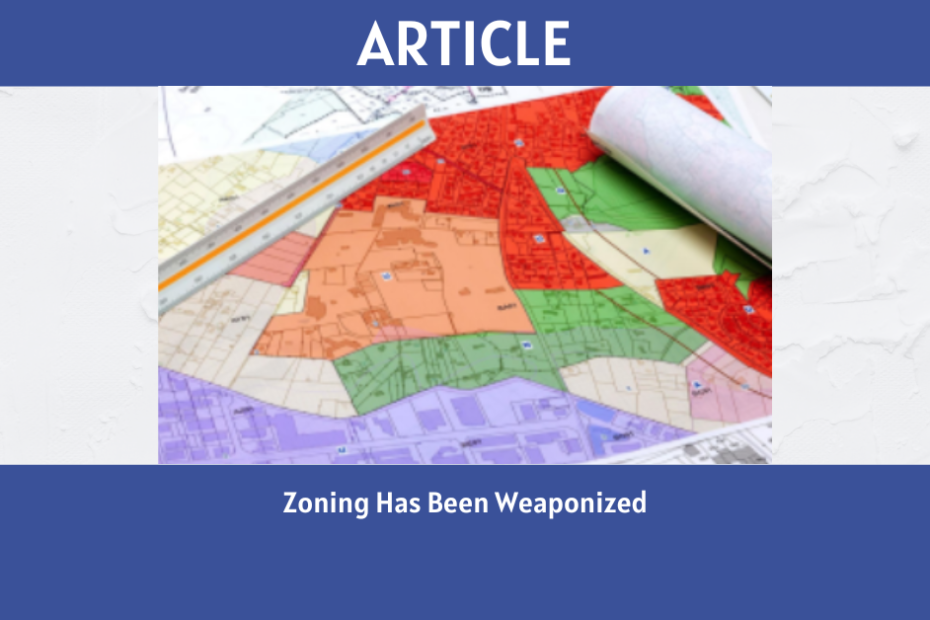
Zoning Has Been Weaponized

Low-density housing typically refers to residential areas occupied primarily by single-family homes or buildings with a limited number of dwellings. There is no set definition, but one characteristic of such an area is that the inhabitants start complaining about any housing development that is too… Read More »Zoning Has Been Weaponized

Saving Los Angeles

To save itself, Los Angeles must return to its original hair color or, as they say, “its roots.” When my great-great-grandfather landed in Los Angeles in 1890, there were commuter trains. Downtown Los Angeles was an actual center city, not simply a name of one of over 400 neighborhoods. Los Angeles’ functional boundary currently has 400 neighborhoods whose names rarely denote anything more than a feeling from a particular time.

Free Newark Now!

Along with New York City, Newark, New Jersey, possesses one of the best locational advantages of any city in the United States. Founded in 1666 by Connecticut Puritans, the town grew by leaps and bounds; the Industrial Revolution sparked a meteoric increase in population and a multi-sector industrial and commercial base. First, canals and then railroads converged into the city. With a population of 8000 in 1820, people poured in, swelling the city’s population to 367,000 by 1910. 

The civic confidence of Newark was such that city leaders in government and business thought it was time to go big. In the era of bold public development, the Meadowlands of New Jersey (known as Newark Meadows) consisted of 46 square miles of what today we would call wetlands but then were called “wastelands.” 4300 acres lay inside the city limits of Newark, and plans were executed and funded by the city to build a port from the “reclaimed” land.

The Public Finance Effects of the Italian Ghost Buildings Program

Does informality hold back tax progressivity, that is, the capacity to tax the rich at a higher rate than the poor? The optimal (and fair) distribution of the tax burden has long been a key issue in both academic and policy circles.

In a new paper, I study whether reducing informality by tackling tax evasion leads policy makers to increase statutory tax progressivity. I take advantage of the Italian “Ghost Buildings” program, which is a policy that identified buildings not registered in the land registry.

Green Acres

Land Value Taxation (LVT) would level the playing field between new farmers and established mortgage-free farmers who presently have a huge (‘I was on the island first’) advantage.

By untaxing jobs and improvements, LVT would bias towards labor-intensive, structure-intensive, value-added farming; this would mean a bias towards organic farms (which both uses less land and uses it more intensively).

Moving the Land to Those Who Will Use It

“Could I begin life again, knowing what I now know, and had money to invest, I would buy every foot of land on the island of Manhattan.”


So wrote one of the original robber barons of the early nineteenth century. Yet almost 200 years later, the idea of holding land as a road to riches is alive and well in New York City. Though, of course, owning land is not so bad when the owner also uses it productively, provides employment, or builds affordable houses. But owning ground to make money on it while doing nothing to it is a problem New York doesn’t need.

In 2022, New York City is facing a new onslaught from the financial sector and their hedge fund billions. The city is enormous––700 square miles. But under the current cruel system, struggling families and small businesses have the nearly impossible task of finding a decent location to live or do business.