
During Hurricane Maria’s prolonged Puerto Rico blackout, one mayor created his own impromptu electric brigade to light up his town. He called it the Pepino Power Authority (PPA). The PPA was a middle finger to a failing centralized grid. Fed up with the inaction, San Sebastián Mayor Javier Jiménez recruited the electricians among his staff, as well as the town’s retired linemen. They reenergized the mountain town. They were heroes. And they were rebels.
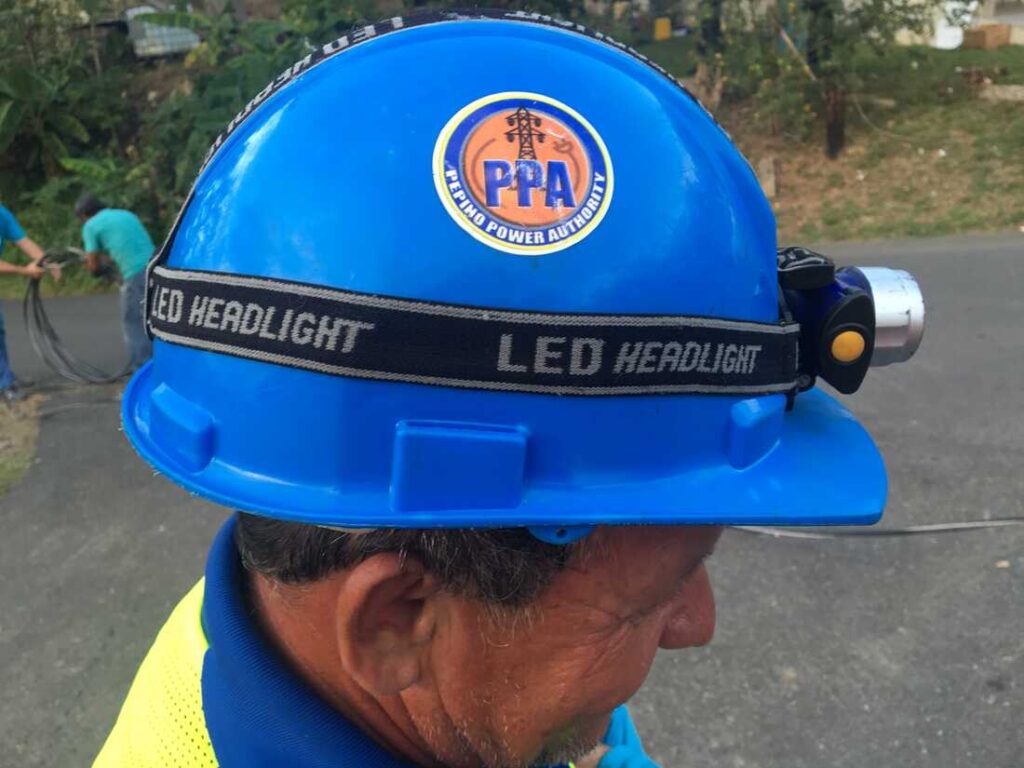
What took a rogue mayor and a crew of linemen in 2017 can now happen through official channels, thanks to newly formalized frameworks for municipal action and receptivity to community collaborations that are legitimizing grassroots effort.
As an embedded researcher and board member of the local CBO Un Nuevo Amanecer Inc. (UNA), based in La Playa de Ponce, Puerto Rico, my community-driven planning consultations throughout Barrio Playa de Ponce have consistently surfaced a grave neighborhood concern: streets have remained persistently dark since Hurricane Maria. Prolonged power outages and sustained darkness carry severe public health and safety consequences, including documented mortality risks associated with extended grid failure. Restoring public street lighting in La Playa is an urgent safety requirement for Los Playeros de Ponce. They’ve told me so. Again and again.
With the help of the US Department of Energy’s Energy Transitions Initiative Partnership Project (ETIPP), UNA’s leadership and community leaders are planning to light up the streets again. This time, though, we plan to use rigorous community research to document need and support formal requests under the new legal frameworks.
The Chronological Legal and Financial Framework
Our timing is perfect. A series of legislative, regulatory, and administrative decisions in 2026 has established a legal mechanism allowing municipalities and communities in Puerto Rico to address public lighting directly:
- February 11, 2026 (Energy Bureau Resolution): The Puerto Rico Energy Bureau approved a resolution reallocating over half a billion dollars in FEMA Federal Award Strategy (FAASt) funds across 35 municipalities. Under this reallocation, $20 million was designated for Ponce, the town where La Playa is located.
- June 22, 2026 (Energy Bureau Regulation 9774): The Puerto Rico Energy Bureau approved Regulation 9774, which officially entered into force on July 22, 2026. Regulation 9774 governs municipal participation in public lighting connected to the electric grid and establishes three intervention tiers: Level I (Basic Maintenance including bulb and photocell replacement), Level II (Supervised Technical Interventions such as pole and conductor replacement), and Level III (Electrical Infrastructure Modifications reserved strictly for grid operators).
The latest development was the governor’s signature on Puerto Rico Law 174-2026.It established a uniform legal framework for formal collaboration agreements between municipalities, the Energy Bureau, and grid operator LUMA to execute authorized lighting repairs and modernization.
For Los Playeros, this law is the missing piece providing the legal authority to turn our research into repairs.
Project LUCES para La Playa and Citizen-Driven Research
Un Nuevo Amanecer Inc. (UNA) is leading local implementation through its innovative LUCES para La Playa initiative.
Developed in partnership with the U.S. Department of Energy’s Energy Transitions Initiative Partnership Project (ETIPP), researchers from the Rocky Mountain National Laboratory, and our local technical partner Hispanic Federation of Puerto Rico, the project builds on the Strategic Energy Plan: Playa de Ponce, published last year (see my blog on the plan). The plan reflects extensive community engagement workshops held at UNA headquarters, Unión de Trabajadores del Muelle de Ponce, and the Villa del Carmen Community Center to broaden participation across the barrio. Neighbors spoke their minds: “We’re tired of dark streets.” “Man, I can’t tell you how many times I’ve called to get that streetlight fixed.” It was the same story in community meetings across the barrio.
UNA and neighbors have now entered a new phase – to give regular people a smartphone application that will give residents and officials a shared, verified picture of streetlight conditions. We’ve co-produced the app with federal ETIPP partners. The hard work of a neighborhood committee—including Beatriz Riefkohl-Durante, Miriam Robles, and Domingo Rodríguez—has guided the creation of the survey tool and we’ve all tested it in the field.
The resulting application will let Juana del Pueblo walk out her door and with a swipe of her phone and a few checkboxes, report the light post conditions and share the GIS location for her entire street in a matter of minutes. With 20 or more volunteers drawn from neighborhood mutual aid networks, community organization, Whatsapp chat groups, and hyperlocal social media pages, we project that we can record each light post’s location, physical condition, and operational status in real time. And we’ll get it done in 2 months — all 2,000 streetlights.
Behind the scenes, the application feeds into an ArcGIS Survey123-driven database. This citizen-driven data will give UNA and the Municipality a verified baseline to prioritize work orders and provide the Municipality of Ponce with the verified baseline needed to request formal collaboration agreements under the recently created legal frameworks and prioritize work orders.
Facility Resiliency and the Municipal-Community Collaboration Model
LUCES para La Playa is also about making UNA’s own building a place Los Playeros can shelter during the next blackout or deadly heatwave. Technical evaluations conducted with ETIPP revealed that UNA’s mini-split air conditioners (220V, 3×18,000 BTU) draw heavy electrical loads upon startup. Installing soft starter kits tempers startup power draw, enabling cooling units to operate safely on solar backup during blackouts. ETIPP will be sizing system upgrades that should be able to secure continuous power for two kitchen refrigerators, UNA’s KP4 system (a short-band radio network used in emergency communications), and community cooling facilities, reinforced by an on-site gas generator for redundant backup generation.
The LUCES para La Playa model offers a practical template for municipal-community collaboration across Puerto Rico. Capturing Ponce’s $20 million federal streetlighting allocation under Law 174-2026 achieves a triple win for the city: driving local economic development and employment, remediating dark streets to improve public safety, and establishing citizen-driven research as a model for municipal governance. For Los Playeros, it may finally deliver long-delayed repairs that prioritize community safety and well-being and upgrade a neighborhood facility with more resilient energy systems for emergency response.
Just as San Sebastian’s community did to take local control, we’re showing how rigorous community-led research in La Playa de Ponce is taking direct charge of our energy future.
