
The ghost of Puerto Rico’s industrial past has re-emerged, amid recent U.S. military actions against Iran that have sent shockwaves through global energy markets, driving oil and gas prices to new heights,. The current crisis recalls the 1973 Arab–Israeli War and OPEC’s oil embargo, highlighting the vulnerability of economies based on extracting local resources for global fossil fuel demand.
A March 3, 2026, investigative report from Telemundo Puerto Rico’s Rayos X [full Spanish broadcast here] examined the decaying legacy of the petrochemical complex along the PR-127 corridor between Peñuelas and Guayanilla. Progress & Poverty Institute’s Senior Associate David Southgate, on the ground in Puerto Rico, was interviewed about this former cornerstone of the 1950s “Operation Bootstrap,” an era led by Puerto Rican economic architect Teodoro Moscoso. “Operation Bootstrap” once promised a permanent economic boom for the island, but instead left behind a 3,500-acre “metal skeleton.”
This provides us with a textbook example illustrating Henry George’s conviction that land and natural resources are a collective inheritance. For 50 years, private entities have profited from this Caribbean US territory without compensating the public for the abuse of its natural resources, leaving the neighboring communities to “cargarle el muerto” (take forced responsibility for a problem caused by others). Environmental degradation, stalled remediation, and prolonged toxic exposures are the heavy burden these neighbors bear.
The TV segment highlights the severe health risks faced by neighboring communities like Tallaboa, where the EPA has identified extensive groundwater pollution from petroleum byproducts and pesticides. Now, as the U.S. asserts greater control over Venezuelan crude in response to the Middle East conflict, rumors of a potential sale and a ‘romanticized’ return to oil refining in Puerto Rico are circulating. However, as Southgate argues, the path forward is not a return to the volatile past, but a transition to sustainable redevelopment—such as solar energy parks, that restores justice and health to the people and the land.
David Southgate’s interview, translated from Spanish to English, appears below. The original broadcast recording is available here in Spanish.
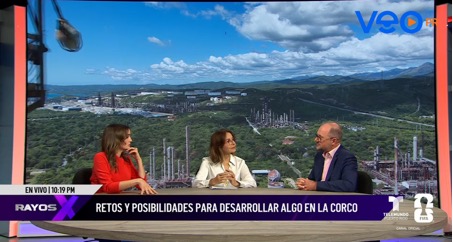
Yolanda Vélez Arcelay:
Well, as Bad Bunny would say, nobody knows what will happen tomorrow.
And this is what happened in the 70s. In 1973, the war came and changed the whole game [referring to the 1973 Arab–Israeli War that provoked OPEC’s oil embargo]. The traces [of the former petrochemical industry] are what’s left in the south of Puerto Rico.
And the question is, what do we do with this? Valeria, who did a very interesting report, brought this history because it has marked generations. And of course, here is David Southgate, who worked on a study for land revitalization in the area.
Greetings, welcome.
David Southgate:
Thank you.
Yolanda:
The conclusions of that study, What were the conclusions and what are the benefits of this study that we can put into action now?
David:
The studies highlighted the fragmentation that you already mentioned, 42 different private owners across 3,500 acres. It is a very complex problem.
Also, the studies highlighted the problems with the area’s infrastructure. Today, if you are going to build a business in an area, it should have enough water, a local electric supply, and adequate sanitary services.
Yolanda:
And that it doesn’t affect the surrounding communities, because they also depend on those resources.
David:
That’s right.
Yolanda:
What happened? Why hasn’t the clean-up and development happened?
David:
So, the other aspect of that area is poverty. Poverty is very stark. 57% of the population living in poverty.
Yolanda:
They need employment.
David:
They need employment, but they also need justice, as Janet and Manolo said [ in Valeria’s report]. Here are the important details about the obstacles to clean-up and redevelopment. In the plans, we have carried out the development of a Master Reuse Plan, developed in the communities, well-developed and very well done.
We have provided a route of development, highlighting the finance development options, themes that are extremely complex. We have made recommendations in public policy, recommending that the government form a special unit of development, a Land Development Authority for that area with the necessary powers to acquire, dispose of, and clean-up the properties, eliminating, among other things, the obstacles of non-collaborating owners.
And the other finding was the contamination.
Valeria:
Those findings, have they reached the hands of officials of…
David:
They reached the Congress of the United States in the plan that RAND Corporation produced for the Recovery of Puerto Rico (Government of Puerto Rico, 2018, p. 372), including other important areas for Puerto Rico’s redevelopment after Hurricane Maria. So, interestingly, a positive outcome for the redevelopment Master Plan was inserted in the RAND Corporation’s recommendation, prepared for COR3 [Puerto Rico’s Central Office for Recovery, Reconstruction, and Resiliency, established in 2017 to manage federal disaster funds].
The other is that it changed public policy in the municipality of Guayanilla, where many people live; they can change the Municipal Land Use Plan, according to the master plan developed in the community.
Valeria:
To do any project there right now, even if it was a photovoltaic field, solar panels, should all of the industrial waste there be removed first? And how viable is that?
David:
So, one of the obstacles also includes the need for collaboration of the owners, who did not allow us to enter their properties, to take the necessary samples of the contaminants.
Yolanda:
Even when they had authority, because the federal agency EPA was the one who gave the funds for this work.
David:
Yes, authority up to a point. But as a quasi-governmental entity, Desarrollo Integral del Sur [a local socio-economic development non-profit] did not possess the political or legal powers to pressure the owners. That is in the hands of the Department of Natural Resources and the Department of Public Health.
Yolanda:
So there is a lack of will, because the state has the authority even to expropriate land for the common good. There has been no will during different administrations of the different political parties to bring the area up-to-date and to provide a route for those communities so that they can develop healthily.
David:
Well, I’m not going to say that there was no interest. Because there was interest under the administration of Alejandro García Padilla and also under the administration of Rosello, who through Manuel Laboy at DDEC [Puerto Rico’s Department of Economic Development and Commerce], we presented all that information. Well, what happened? We don’t know.
I stopped working in the project in 2019 to do other life things, work things.
Valeria:
I should mention that we asked several times to interview the current Puerto Rico Secretary of Economic development to hear more about the current plans, and part of the work program that it could be relevant. But the Secretary was not available due to consecutive trips.
Yolanda:
I have two questions. Number one, what we saw in 1973––putting all the eggs in the same basket, and using raw material that we didn’t produce, but we didn’t produce the oil.
I know there was a good intention, we wanted to act in the country’s interest, but unfortunately the war broke everything, threw away the pieces of the table and brought us these realities. Now we face a war in the Middle East, we return to having the same circumstances of oil, shooting, natural gas, etc. Is there a viable project that has to do with fossil fuels?
David:
Well, first of all, what we’re talking about is extraction, an extractive public policy. What we have as a result is a contaminated area where the neighbors don’t know what they are breathing nor what it is under their feet. And a laissez-faire approach has left them like that.
Yolanda:
I ask, because there are also aquifers there, etc. We have seen a change of environmental policy under President Trump. Is it viable, making progress on cleaning up the area and at the same time achieving economic development that does not affect the neighboring communities?
David:
Well, the Trump administration has an America-first policy that favors American fuel, for obvious reasons. Puerto Rico is nothing more than a market for that purpose. The consumption of natural liquid gas, we already understand that story in the south of the efforts in Puerto Rico to bring it through the Port of Ponce. The people of Ponce Playa said no, right?
And then I imagine that the people of Penuelas and Guayanilla will also organize themselves and say no. Is the of Trump administration is currently going to favor an eco-friendly area, or an Eco-Industrial area for production on a utility scale of photovoltaic energy and the recovery of raw material from recycling, and a park for green technological innovation? Well, I doubt it, but Trump will not live forever, and neither will he be president forever.
Yolanda:
You have to plan for a long term.
David:
Exactly. You must have a long-term plan and a long-term view, because that project will not be solved in one, nor two, nor three political administrations.
Valeria:
At various times, there have been rumors circulating about possible development in that area. If a developer wants to acquire one of the contaminated properties, will development be possible with that level of contamination? Development, for example, that does not have an industrial impact?
David:
Well, yes, that’s what the master plan is. But during the ten years of work on this project, I received numerous calls from entities and people who intend to do an eco-friendly Eco- Industrial project in this area. But they did not have financial capital, nor did they have an experienced and qualified team. So, you have to ascertain whom you are going to trust.
Yolanda:
I hope that the area develops. Heck, here we are decades later working to recover Roosevelt Roads [a former United States Navy base in the town of Ceiba, Puerto Rico] and we are still waiting. Thank you, thank you, Professor.
And now we move on to Adrián and José Carlos.
