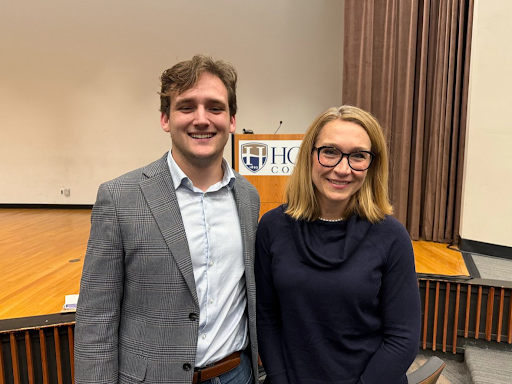
In my role as Executive Director of the Progress and Poverty Institute I get to travel a fair amount and talk to all kinds of people about Henry George’s ideas, in particular, the Land Value Tax (LVT). Recently, I had the pleasure of speaking at a CivicCon event at Hood College in Frederick, Maryland, a smallish town with a charming historic district, a handful of landmarks and museums, and a genuine problem with housing affordability.
The event, titled “Reimagining Property Taxes to Capture Community-Created Value” was, as the name suggests, all about how shifting taxes onto land values captures community-created value and incentivises the creation of new housing. (And as we know, more housing = cheaper housing, a relationship very recently, and very convincingly, demonstrated by PPI collaborator, Luke Teeter of Thrive Economics, in his study of Denver’s rental market.)
The evening was a lot of fun, and my co-presenter, Greg Miller, CEO of the Center for Land Economics, and I were deeply impressed by folks’ willingness to brave a bitterly cold January evening to talk taxes. The highlight of the night was (as always) the Q&A, and I particularly enjoyed getting to interact with a former assessor turned appraiser, who had a deep bench of applied knowledge and an appetite for new ideas.
Happily, I wasn’t just there for the evening lecture, however. I also had the opportunity to tour Frederick and learn the stories behind many of its neighborhoods, streets, and shopping areas. My tour guide for this little excursion: historic district resident, professional planner, and LVT advocate extraordinaire, Alan Feinberg.
Through the windows of Alan’s Hyundai I saw new, sprawling townhouse developments with elaborate brownstone-inspired frontages and cheap plastic siding-clad backsides. I observed a handful of shuttered storefronts among the lineup of cute downtown bookshops and florists, all owned by the same person who seems perfectly content to keep them vacant for as long as it takes to eventually “sell high.” And I took in “the Golden Mile,” which, while hardly down at the heels compared to some of the more disinvested cities in my home state of New Jersey, lacks the upper class burnish of most of the rest of the town.
I also had an opportunity to talk about Henry George and Land Value Taxes, with Russ Hodge of 3 Roads Communications. No stranger to these topics, Russ and company recently produced a short documentary about Baltimore Thrive – a group of advocates working to bring LVT to Charm City. That piece, and mine, are available on 3 Roads’ YouTube Channel and you should definitely go check them out.
I’m acutely aware that I talk and think about LVT a lot more than the average person. That’s literally my job, after all. But even taking my own bias into account, it’s becoming increasingly clear that – from small towns like Frederick to big cities like Baltimore and even entire states (I’m thinking here of Washington, New York, Colorado, and all the rest with enabling legislation on the table) – the movement to shift taxes onto land values is gaining speed across the U.S.
PPI celebrated its 100th year of operations last year. And at our centennial celebration a guest recalled the long ago sentiment of a fellow Georgist that “the time just isn’t right for Henry George.” I’m here to say that today – in spite of (or perhaps because of) the profound unrest rocking our country – the time finally is right for Henry George again.
So, if you have an audience that’s interested in exploring Land Value Taxes, drop me a line. Bonus points if we can tour your hometown while we’re at it.